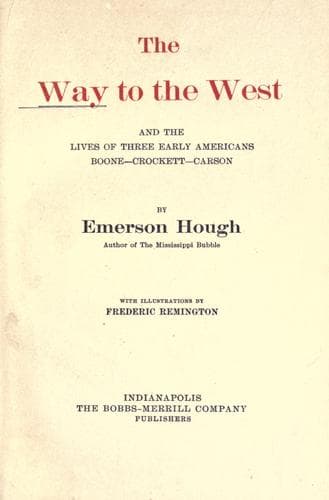
The Way to the West, and the Lives of Three Early Americans: Boone—Crockett—CarsonHough, Emerson
History
The Way to the West, and the Lives of Three Early Americans: Boone—Crockett—Carson
Hough, Emerson
Boone, Daniel, 1734-1820; Carson Kit, 1809-1868; Crockett, Davy, 1786-1836; Mississippi River Valley -- History; West (U.S.) -- History
“They have done more to develop the wealth and resources, to stimulate
the industry, reward the labor, and promote the general comfort and
prosperity of the country than any other, perhaps than all other mere
physical causes combined. There is probably not a man, woman or child
whose interest or comfort has not been in some degree subserved by them.
They bring to our doors the productions of the earth. They enable us to
anticipate and protract the seasons. They enable the inhabitants of each
clime to enjoy the pleasures and luxuries of all. They scatter the
productions of the press and of literature broadcast through the country
with amazing rapidity. There is scarcely a want, wish, or aspiration of
the human heart that they do not in some measure help to gratify. They
promote the pleasures of social life and of friendship; they bring the
skilled physician swiftly from a distance to attend the sick and the
wounded, and enable the absent friend to be present at the bedside of
the dying. They have more than realized the fabulous conception of the
Eastern imagination, which pictured the genii as transporting inhabited
palaces through the air. They take a train of inhabited palaces from the
Atlantic coast, and with marvelous swiftness deposit it on the shores
that are washed by the Pacific sea. In war they transport the armies and
supplies of the government with the greatest celerity, and carry
forward, as it were on the wings of the wind, relief and comfort to
those who are stretched bleeding and wounded on the field of battle.”
He has not read well the history of his country, has not learned the
intricate web of the commercial system of to-day, has surely not studied
the developments of the third age of American transportation, who can
believe that there exists any longer any considerable difference between
the most widely separated parts of America in matters of the gentler
life. The publisher of a noble periodical controls an agency the
influence of which is as valuable and as much desired in the West as in
the East, and which is felt as quickly and as sensitively in the one
region as the other. The art and literature of the time belong to the
West as much as to the East, and in its due time the West will produce
as well as consume in the matters of art and literature. There were
Western artists, Western painters, Western sculptors on the plains
before the buffalo were gone.
Public-domain text, read in full here on John Shaqi.
Reviews
Reviews
No reviews yet
Be the first to share your thoughts on this work.
Elsewhere in the archive
Join the Discussion
Join the discussion
Sign in to leave a comment or review.
Sign InorCreate an account