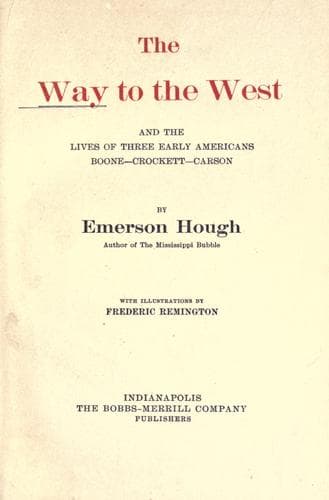
The Way to the West, and the Lives of Three Early Americans: Boone—Crockett—CarsonHough, Emerson
History
The Way to the West, and the Lives of Three Early Americans: Boone—Crockett—Carson
Hough, Emerson
Boone, Daniel, 1734-1820; Carson Kit, 1809-1868; Crockett, Davy, 1786-1836; Mississippi River Valley -- History; West (U.S.) -- History
We have an overgrowth, or, rather, too sudden and rank a growth, of
transportation in America. It is attended with sudden changes, attended
also with a certain weediness and immaturity, which we should be
entitled to call un-American and undesirable, even were it not for the
graver features that amount to revolutionary changes and to national
menaces. Borne aloft upon a great wave of commercial prosperity, the
American people is at the present time taking itself with entire
seriousness as the greatest nation of the world. Its rapid industrial
expansion has indeed been cause for marvel in the mind of all the world.
There is a certain national comfort in these reflections, without doubt,
and solace in the almost incomprehensible totals of the figures on which
such assertions are grounded. Therefore it must come almost with ill
grace to offer in these days of jubilation any word that might seem to
indicate that perhaps, in spite of all this superficial prosperity, all
may not be well with America as a nation, that all is not really well
with our American man.
We are told that these are good times, the best we ever knew. It is
triumphantly announced to us that we have in one year invested nearly
seventy millions of dollars in foreign securities, largely in railroad
bonds of Russia, in German Treasury bills, and English Exchequer loans.
This is very good; it sounds well. As an offset to it one should
apologize for offering the simple but multifold statements from the
columns of the daily press bearing upon the greater cost of living in
Western states. It is seven per cent. greater, says one dealer in
statistics. It is twenty-five per cent. greater than it ever was, says
another. The housewives of America, the best of all statisticians, say
that in 1902 it cost thirty-three per cent. more to live than it did in
1899. These prices of bare commodities in these days of super-excellent
transportation go well toward comparing with those we have shown as
existing in the far-off mountain communities in the days of pack-horse
and ox-team transportation. If this be so, is all well with America? The
prices are the results of combinations and monopolies. The monopolies
are based largely on non-competitive transportation. The iron trails are
built over the hearthfires of America. The iron trails must do otherwise
than thus.
We are informed that during the last year the balance of trade in favor
of the United States was something like seven hundred millions of
dollars. “Figures up to March twenty-first (1902), just finished,” says
a careful report, “are so stupendous as to be staggering. * * * Nations
have generally measured their prosperity by their foreign trade.”
Public-domain text, read in full here on John Shaqi.
Reviews
Reviews
No reviews yet
Be the first to share your thoughts on this work.
Elsewhere in the archive
Join the Discussion
Join the discussion
Sign in to leave a comment or review.
Sign InorCreate an account