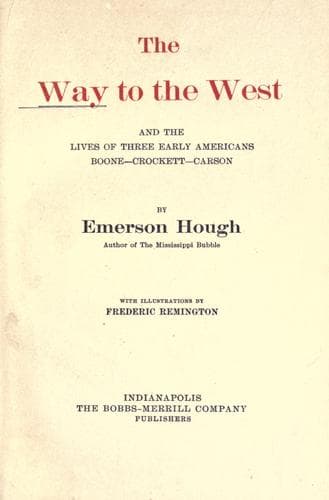
The Way to the West, and the Lives of Three Early Americans: Boone—Crockett—CarsonHough, Emerson
History
The Way to the West, and the Lives of Three Early Americans: Boone—Crockett—Carson
Hough, Emerson
Boone, Daniel, 1734-1820; Carson Kit, 1809-1868; Crockett, Davy, 1786-1836; Mississippi River Valley -- History; West (U.S.) -- History
“Our American railroads were, not a very long time since, owned largely
outside the United States, but during the world’s panic that occurred in
1893, our British, German and Dutch friends discovered the necessity of
selling something, and the only things in their strong boxes that they
could sell without too much sacrifice were their American securities.
They dumped them on the American market; and, notwithstanding the
financial strain and the depression from which we were suffering, our
American financiers mustered pluck, courage and money enough to buy
them. They were bought at bargain prices. The advance in them has been
stupendous, but it is worth a great deal to feel that we are not only
blessed with the most improved and cheapest transportation in the world,
but that our railroads are owned by our own people. The value of the
railroads of the United States amounts to over one-fifth of the total
wealth of the country.”
Another master in transportation,[61] in a public address delivered in
1902, gave yet further details in the vivid story of the extension of
the iron trails of America: “While the railroads may have to answer for
many mistakes of judgment or of intent,” said he, “on the whole the
result has been to create the most effective, useful, and by far the
cheapest system of land transportation in the world. In England the
average amount paid by the shipper for moving a ton of freight one
hundred miles is two dollars and thirty-five cents; in France, two
dollars and ten cents; in Austria, a dollar and ninety cents; in
Germany, where most of the railroads are owned and operated by the
government, a dollar and eighty-four cents; in Russia, also under
government ownership, where the shipments are carried under conditions
more nearly similar to our own than any other country as respects long
haul, a dollar and seventy cents. In the United States the average cost
is seventy-three cents, or less than forty per cent. of the average cost
in Europe.”
From the above comparisons this captain of transportation concludes that
the railroad industries of this country are in a flourishing condition
and that they should not be interfered with. Yet he concludes his
comment with words that contain a corollary inconsistent with his
earlier attitude, as we may later have occasion to note. He says: “For
the first time in the history of this country thousands of our farmers
are seeking homes in the Canadian Northwest, owing to the cheap lands
offered in that country, and to the difficulty of securing such lands in
the United Slates.” Earlier in the same address there is this
epigrammatic statement: “Land without population is a wilderness;
population without land is a mob.” If our Western Americans are leaving
the flag of a republican government to seek land elsewhere, is not the
inference fair that they do so because they have become a population
without land? If this be true, assuredly it is the work of the iron
trails.
Public-domain text, read in full here on John Shaqi.
Reviews
Reviews
No reviews yet
Be the first to share your thoughts on this work.
Elsewhere in the archive
Join the Discussion
Join the discussion
Sign in to leave a comment or review.
Sign InorCreate an account