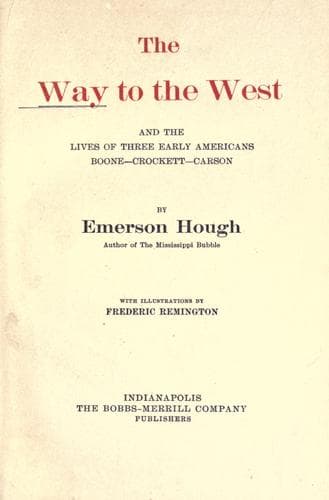
The Way to the West, and the Lives of Three Early Americans: Boone—Crockett—CarsonHough, Emerson
History
The Way to the West, and the Lives of Three Early Americans: Boone—Crockett—Carson
Hough, Emerson
Boone, Daniel, 1734-1820; Carson Kit, 1809-1868; Crockett, Davy, 1786-1836; Mississippi River Valley -- History; West (U.S.) -- History
This is in America, and in the Age of Transportation! I read of these
startling changes and can scarcely believe that they have happened
within a lifetime, a part of which was passed in a West where wealth and
poverty, arrogance and self-denial, were alike unknown; where, if one
hungered, he was free to enter the door of any little cabin he found
here or there in the mountains, and to eat freely of whatever food he
found, though the owner of the abode himself might be absent and might
forever remain unknown; where the thought of price did not enter into
the mind of either the uninvited visitor or his unknown host; where
herds, wild or tame, covered a country vast, inviting and hospitable;
where each man was his own leader; and where the thought of any
difficulty in the simple problem of making a living never entered into
the heart of man!
Those were days perhaps of not so great and apparent a national
prosperity, but there comes a catch in the throat at comparing those
days with these. The horror of it, the shameless waste, the destruction,
the change, the ruin of it all—these can leave us little comfort as we
gaze on the glittering picture of to-day. As a nation we are building
for ourselves higher and higher a false castle of prosperity, blowing
for ourselves wider and wider a bubble fragile at heart as any that ever
met collapse in another day. “Give me back my legions!” cried the Roman
general. God grant there may never bitterly rise to the lips of an
American leader the unavailing cry, “Give me back my Americans!” God
grant there come not too late the cry, “Give us back our America!”
“Taking it all around,” says an unprejudiced writer, “the present
generation in the United States reminds one of a young spendthrift just
come into a fine property, accumulated by the thrift and carefulness of
many ancestors. He thinks he is something out of the ordinary, and
intends showing others how things should be done. In the society of
flatterers, speculators and gamblers, he soon parts with his ready money
and bank stock. He then sells the timber off his land. After that is
spent he sells his live stock. Having thus deprived himself of the means
for the proper tillage of his soil, he then sells the hay crop from his
meadows until they are no longer productive. He next mortgages his
property; and the last scene in the final act is the auctioneer’s hammer
at the public vendue.”[62]
Public-domain text, read in full here on John Shaqi.
Reviews
Reviews
No reviews yet
Be the first to share your thoughts on this work.
Elsewhere in the archive
Join the Discussion
Join the discussion
Sign in to leave a comment or review.
Sign InorCreate an account