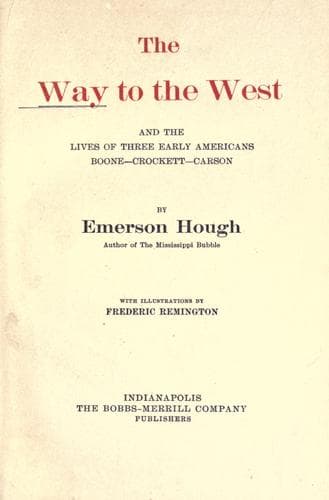
The Way to the West, and the Lives of Three Early Americans: Boone—Crockett—CarsonHough, Emerson
History
The Way to the West, and the Lives of Three Early Americans: Boone—Crockett—Carson
Hough, Emerson
Boone, Daniel, 1734-1820; Carson Kit, 1809-1868; Crockett, Davy, 1786-1836; Mississippi River Valley -- History; West (U.S.) -- History
Another commentator[63] takes up the same trend of thought: “The cry of
the people of the West,” says he, “is rising almost to the ominous
threat of revolution. The wealth of the country has increased
enormously, but it is becoming concentrated in the hands of a
comparatively few individuals. Only in the days of the early empire and
late republic of Rome was it possible for a few individuals in a few
years to amass such enormous fortunes as they do. Having exploited the
wealth of the great middle class, we are now drifting into the second
stage. Small investments no longer pay. There is no Eastern or Western
state that has not a score of stranded towns and villages once
prosperous in small industries. The small farmer is no longer able to
make a living in the competition which he meets.... All this may be
progress, but it is progress over a precipice.”
Still another observer[64] carries his conclusions yet further, and in a
public address states: “The work of such men as [this monopolist] and
his associates of the big combinations is preparing the minds of our
people for socialism. I am not in favor of socialism, but men like these
so-called captains of industry, who are opposed to socialism, are
preparing the way for the rapid spread of the socialistic idea. Should
some able leader take up that idea and advocate it, we shall see it
spread with tremendous rapidity in America.”
So much for the accomplishments of the Age of Transportation. It has
already shown us the meaning of monopoly and has shown us the
abolishment of the individual. It has taught us, or some of us, to
believe that the establishment of an expensive university may serve as
emendative of an unpopular personal career. It has taught us, or some of
us, obsequiously to worship that form of wealth that soothes its
conscience by the building of public libraries. Whether or not learning
best grows and flourishes that has such foundation heads, library and
university alike must to-day admit their impotence to answer the cry of
the leader, “Give me back my Americans!”
The America of to-day is an America utterly and absolutely changed from
the principles whereon our original America was founded, and wherefrom
it grew and flourished. Never was there any corner of Europe, before the
days of those revolutions that put down kings, worse than some parts of
oppressed America to-day. It is not too late for revolution in America.
There is not justice in the belief that America can to-day be called the
land of the free. The individual is no more. He perished somewhere on
those heights we have seen him laboriously ascending, somewhere on those
long rivers we have seen him tracing. He died in the day of Across the
Waters.
Public-domain text, read in full here on John Shaqi.
Reviews
Reviews
No reviews yet
Be the first to share your thoughts on this work.
Elsewhere in the archive
Join the Discussion
Join the discussion
Sign in to leave a comment or review.
Sign InorCreate an account