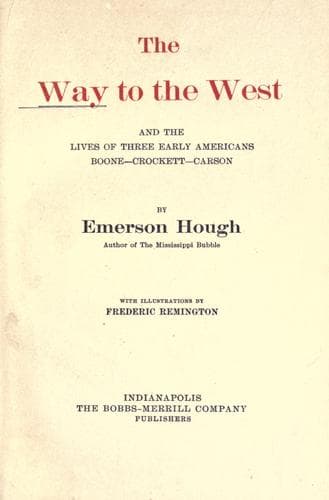
The Way to the West, and the Lives of Three Early Americans: Boone—Crockett—CarsonHough, Emerson
History
The Way to the West, and the Lives of Three Early Americans: Boone—Crockett—Carson
Hough, Emerson
Boone, Daniel, 1734-1820; Carson Kit, 1809-1868; Crockett, Davy, 1786-1836; Mississippi River Valley -- History; West (U.S.) -- History
IN THE YEAR 1834 IT BECAME NO LONGER
PROFITABLE TO TRAP THE BEAVER
------------------------------------------------------------------------
PREFACE
The customary method in writing history is to rely on chronological
sequence as the only connecting thread in the narrative. For this reason
many books of history are but little more than loosely bound masses of
dates and events that bear no philosophical connection with one another,
and therefore are not easily retained in the grasp of the average mind.
History, to be of service, must be remembered.
A merely circumstantial mind may grasp and retain for a time a series of
disconnected dates and events, but such facts do not appeal to that more
common yet not less able type of intellect that asks not only when, but
why, such and such a thing happened; that instinctively relates a given
event to some other event, and thus goes on to a certain solidity and
permanency in conclusions. Perhaps to this latter type of mind there may
be appeal in a series of loosely connected yet really interlocking
monographs upon certain phases of the splendid and stirring history of
the settlement of the American West.
Not concerned so much with a sequence of dates, or with a story of
martial or political triumphs, so called, the writer has sought to show
somewhat of the genesis of the Western man; that is to say, the American
man; for the history of America is but a history of the West.
Whence came this Western man, why came he, in what fashion, under what
limitations? What are the reasons for the American or Western type? Is
that type permanent? Have we actual cause for self-congratulation at the
present stage of our national development? These are some of the
questions that present themselves in this series of studies of the
manner in which the settlement of the West was brought about.
The history of the occupation of the West is the story of a great
pilgrimage. It is the record of a people always outstripping its leaders
in wisdom, in energy and in foresight. A slave of politics, the American
citizen has none the less always proved himself greater than politics or
politicians. The American, the Westerner, if you please, has been a
splendid individual. We shall have no hope as a nation when the day of
the individual shall be no more. Then ultimately we shall demand Magna
Charta over again; shall repeat in parallel the history of France in
’93; shall perhaps see the streets run red in our America. There are
those who believe that the day of the individual in America is passing
all too swiftly, that we are making history over-fast. There is scant
space for speculation when the facts come crowding down so rapidly on us
as is the case to-day. Yet there may perhaps be some interest attached
to conclusions herein, which appear logical as based upon a study of the
manner in which the American country was settled.
Public-domain text, read in full here on John Shaqi.
Reviews
Reviews
No reviews yet
Be the first to share your thoughts on this work.
Join the Discussion
Join the discussion
Sign in to leave a comment or review.
Sign InorCreate an account