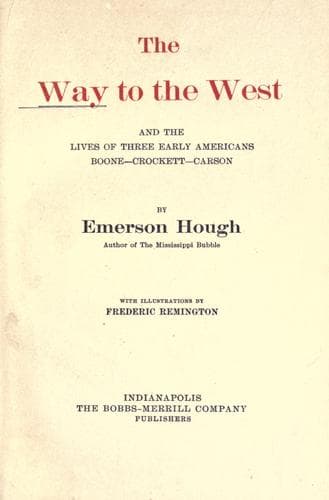
The Way to the West, and the Lives of Three Early Americans: Boone—Crockett—CarsonHough, Emerson
History
The Way to the West, and the Lives of Three Early Americans: Boone—Crockett—Carson
Hough, Emerson
Boone, Daniel, 1734-1820; Carson Kit, 1809-1868; Crockett, Davy, 1786-1836; Mississippi River Valley -- History; West (U.S.) -- History
We Americans have claimed this continent for humanity. We say that
America is not to be used by the Old World as colonization ground, or
for the planting ground of Old World ideas of government; and yet, even
as we speak these words, we vitiate doctrine even wider than the Monroe
doctrine—the doctrine of common sense. We throw open the gates of
America and invite the sodden hordes of worthless peasantry to flock
hither and pillage this country, the choicest of the continent, without
let or hindrance, without requiring of them the first standard of
fitness for American citizenship; without asking of them even the
slightest educational test as to their fitness to enter into and enjoy a
part of the once splendid heritage of this American people. The only
price we ask is a ticket and a vote.
Of a truth, there would be justice in saying that we would better watch
not so much South America as Castle Garden. There is where much of the
degradation and depression of American life is going on. There is where
trades-unionism begins, and indeed must begin. There is where monopolies
begin. There is where, indeed, we are being colonized by the European
peoples. For those that come here to work, to study, to learn and to
grow there may be room yet in this great America. For those that come
here to exist as parasites there should be no longer any room. All this
is to some extent the act of common carriers in search of commerce.
Behind this search there often lies all too certainly the intent of
importation of a passive and semi-servile class,[65] content to accept
the hardest conditions of life, and content to accept life barren of all
hope, of all chance for future betterment.
Such life is un-American. Every one of these foreigners comes here with
a vote in his hand. We have long allowed the vote to pay for everything;
and, seeing that he had a vote, the poor foreigner though turbulent and
discontented, has perforce satisfied himself with an America not much
better and not much different from Europe. Assuredly, the time will
come, and perhaps presently, when there must be considered with all
seriousness this question of a mis-chosen and wrongfully used factor in
our commercial fabric. It is not the upper branches of our model system
of commerce which are wrong, nor will pruning those upper branches set
that wrong right. We must go to the root of things.
Surely we have gone forward far enough in our commercial growth to learn
that our country is not exhaustless. Were it so we should not to-day be
considering the expenditure of hundreds of millions of dollars to
stretch the shrunken acreage of the once boundless West. Once we had
enough for all, but now we no longer have enough for all. Once we could
keep open house, but we can now no longer do so. There comes a time even
in the question of open house when the doctrine of self preservation,
greater than any Monroe doctrine, greater than any constitution, must
have its place.
Public-domain text, read in full here on John Shaqi.
Reviews
Reviews
No reviews yet
Be the first to share your thoughts on this work.
Elsewhere in the archive
Join the Discussion
Join the discussion
Sign in to leave a comment or review.
Sign InorCreate an account