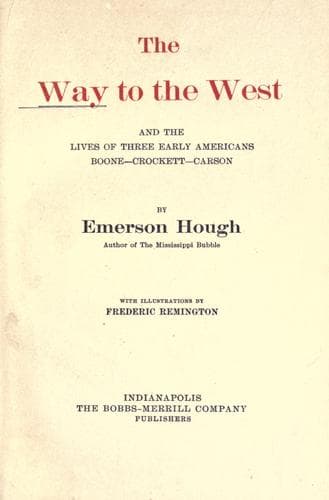
The Way to the West, and the Lives of Three Early Americans: Boone—Crockett—CarsonHough, Emerson
History
The Way to the West, and the Lives of Three Early Americans: Boone—Crockett—Carson
Hough, Emerson
Boone, Daniel, 1734-1820; Carson Kit, 1809-1868; Crockett, Davy, 1786-1836; Mississippi River Valley -- History; West (U.S.) -- History
To-day we have labor unions, organizations that in the old West would
have called forth indignant contempt in the mere suggestion. We have
associations of managers to fight the unions; we have monopolies,
combinations, masses, upon the one side and the other, contending, not
working together harmoniously. We have become par excellence the people
of castes and grades and classes. The whole theory of America was that
here there was hope for the individual; that here he might grow, might
prevail. It is degradation to abandon that theory. It is degradation for
the American man to say of his own volition: “I am but one cog of a
wheel, and my neighbor another. I can not change; I can not rise; I can
not progress; I can not grow; I dare not hope.” The degradation of the
industry shares the degradation of the individual. The joint
degradation, if it be accepted as final, spells a national deterioration
and a national ruin which may be gradual and slow, or may, in these
swift-moving days, be rapid and cataclysmic in its nature.
We have departed from the careful intent of that government which
originally abolished for us even the law of primogeniture, a clause
adopted in the state constitutions nearly throughout the Union. Our
general public is more absolutely ruled by a few than is the case in any
portion of the earth. Offsetting this, we boast of our “prosperity”! Let
those that like call this a national prosperity. It is national fate,
but there may be those that do not care to call it by the name of
prosperity. Times are good when all the people are busy. Most of the
people in the South were busy before the war; we called that slavery. It
was as nothing compared to the industrial slavery impending over the
American people to-day. It was simple by comparison as a problem.
Tremendous indeed is the problem this implies, and grave and serious
indeed should he be who attempts to solve it. We need statesmen, not
politicians, to-day. We need men willing to do their duty in office,
without regard to the question of their re-election to office.
We have promised that our study of American transportation should bring
us close to the heart of things in our national life. The promise may be
made good in the review of the work of the iron trails in the Age of
Transportation. It would be but raving to hold the captains of
transportation alone responsible for the deplorable changes that are
taking place in America and the American character; yet only an equal
folly could deny that too little fearless statesmanship, combined with
too much politics and too much ungoverned transportation, has been
responsible for many of these changes. Any candid student of American
transportation and of American politics will find himself irresistibly
arriving at the great question of the unrestricted American immigration.
Public-domain text, read in full here on John Shaqi.
Reviews
Reviews
No reviews yet
Be the first to share your thoughts on this work.
Elsewhere in the archive
Join the Discussion
Join the discussion
Sign in to leave a comment or review.
Sign InorCreate an account