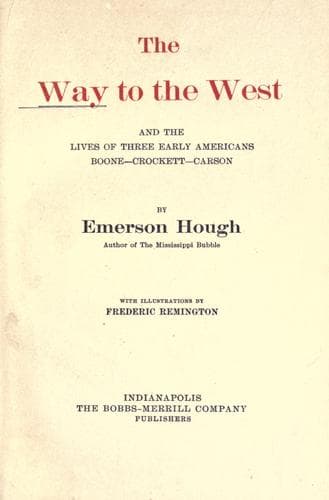
The Way to the West, and the Lives of Three Early Americans: Boone—Crockett—CarsonHough, Emerson
History
The Way to the West, and the Lives of Three Early Americans: Boone—Crockett—Carson
Hough, Emerson
Boone, Daniel, 1734-1820; Carson Kit, 1809-1868; Crockett, Davy, 1786-1836; Mississippi River Valley -- History; West (U.S.) -- History
The reply to such prophecy or foreboding, or guessing, as one may choose
to call it, which has been provided by the government of England, is not
apt to take any form different from the ancient policy of England, which
after all is military. England is old and is, or presently will be,
decadent. Her bigotry is that of age, her unprogressive slowness of
change is senile. She has been the great colonizer; and in so far as the
development of transportation facilities has brought her colonies closer
home to her, it has given England hope—her only hope—that of existing
in the future of her robust children. Yet we find the concern of England
to-day to be that of securing military touch with all the corners of the
world, rather than that of establishing a flexible and durable system of
transportation methods that shall make for the individual well-being of
all her widely scattered subjects.
England, concerned with this American invasion of settlers, is to-day
planning a great trans-Canadian road, whose western head shall lie
somewhere within striking distance of Asia. “This,” says one
commentator, “is England’s answer to Russia and the trans-Siberian
railway.” To a humble observer it might seem far safer were England
concerned, not so much in answering Russia, as in answering the United
States.
The best answer to Russia would be multitudes of farms in Western
Canada, which one day we may call Western America. She can make that
answer only by learning the methods of the United States. Till in some
measure she shall have done so, she can not be safe as against the
inroads of the American citizens. She can not restore the level of the
waters by the building of railroads with military reasons under them.
There may be a time in the history of the North American mid-continent
when Canada and the United States will agree that it is better to get
along comfortably together than it is to aid a far-off and somewhat
mythical government to fight its battles somewhere at the end of
military roads.
Our little Western secessionists, our little frontier republics cleaved
to the government at Washington as soon as the pathways thereto made
such loyalty a possible thing. It is nearer from Quebec and Ottawa to
Washington, than it is to London. Patriotism is much a matter of
transportation. The faster the ocean steamships, the better the
telegraphic communication, the nearer Canada is to England; yet at the
same time relatively she grows still nearer to the United States.[66]
Public-domain text, read in full here on John Shaqi.
Reviews
Reviews
No reviews yet
Be the first to share your thoughts on this work.
Elsewhere in the archive
Join the Discussion
Join the discussion
Sign in to leave a comment or review.
Sign InorCreate an account