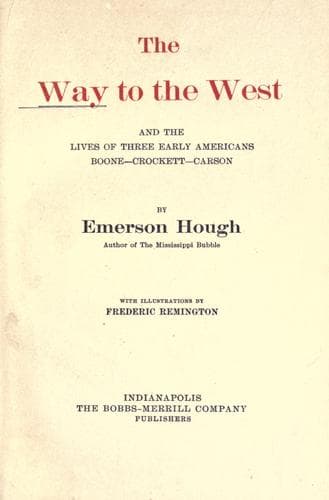
The Way to the West, and the Lives of Three Early Americans: Boone—Crockett—CarsonHough, Emerson
History
The Way to the West, and the Lives of Three Early Americans: Boone—Crockett—Carson
Hough, Emerson
Boone, Daniel, 1734-1820; Carson Kit, 1809-1868; Crockett, Davy, 1786-1836; Mississippi River Valley -- History; West (U.S.) -- History
Germane to these questions are those that rise as to the opening of
additional avenues of industry at the other end of those pathways that
stretch out across the Pacific Ocean. In the mad race for the gates of
the imperial city of China, America had no real friends at her side.
That was the time when the covetous powers of Europe, owners of lands
overpopulated and industries overcrowded, conceived that they had at
length opportunity to urge quarrel on a weaker land, with the result of
a war in which the weaker power would inevitably be obliged to pay the
penalty of unsuccessful resort to arms. England and Germany wished to do
what England had been doing in South Africa and elsewhere for some time.
They wanted a quarrel and a war, therefore a dismemberment and a
division. Water transportation is cheap. The coal and iron of China lie
close to water transportation. It had excellently well served the
designs of England and Germany to parcel out this land, so full of raw
material fit for manufacturing purposes. It had excellently well suited
the powers to wipe the barbarians off the map, as has been done in so
many South Asiatic and South African transactions of a similar nature.
The secret of the Christian indignation at the barbarity of the heathen
Chinese is none too much a secret in the frank vision of commercial
desire.
The part of America in this game was well played. It is too late now to
cry out for an America for Americans. We have squandered our substance,
wasted our heritage, played the spendthrift royally as we might. Now it
is too late. We may shut our gates on the East, but we must some time
take our part in the great game of going abroad in the West. We have not
yet felt that time to be near at hand; but it was splendid statesmanship
on the part of America that kept China intact for yet a while, and got
the armies off her soil.
Public-domain text, read in full here on John Shaqi.
Reviews
Reviews
No reviews yet
Be the first to share your thoughts on this work.
Elsewhere in the archive
Join the Discussion
Join the discussion
Sign in to leave a comment or review.
Sign InorCreate an account