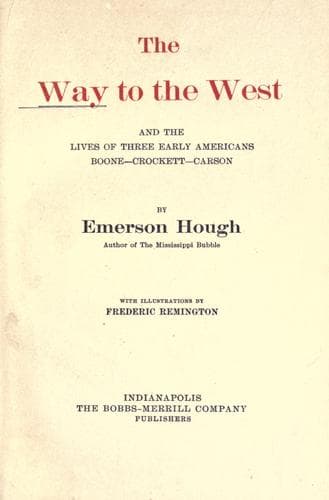
The Way to the West, and the Lives of Three Early Americans: Boone—Crockett—CarsonHough, Emerson
History
The Way to the West, and the Lives of Three Early Americans: Boone—Crockett—Carson
Hough, Emerson
Boone, Daniel, 1734-1820; Carson Kit, 1809-1868; Crockett, Davy, 1786-1836; Mississippi River Valley -- History; West (U.S.) -- History
The blandishments of England and Germany ought not to appeal to America.
There is no nation that loves us unselfishly, or that would aid us
unselfishly were we in need of help;[67] but if it shall one day come to
the last bitter game among the nations, there will be none then so well
equipped as we. We shall not need to call for aid. An English journal
deems it “crude vulgarity” for the United States to think of wresting
the maritime supremacy from Great Britain. It may be such, though we are
not sure. It was perhaps crude vulgarity when we took America from Great
Britain, when we took for ourselves a country so full of natural wealth,
a country so perfect for the upbuilding of an aggressive and
self-reliant national character. It might be crude vulgarity if we took
this whole American continent as our own. Let us hope that this same
character may still abide with us when we find need for the farther
crude vulgarity of going abroad into the world. That we are meantime
going abroad is without question true; not at the direction of our
“leaders,” not by reason of our politics, but by reason of our
transportation.
The South, always the leader into the West, exclaims politically against
the look toward Asia. It is but politics. The Tennessee troops fought
well in the Philippines. Not all the world can stop us from thus going
abroad. Whether we shall come home again at a later date remains yet to
be seen. Whether we shall then have left a home worth the name remains
yet to be proved.
Such are some of the localities and situations into which our trails
have nationally led us; such some of the problems into which our vaunted
Age of Transportation is carrying us. There are new equations, new
questions, new problems constantly confronting us with an ever growing
urgency. It is not in any wise certain that a dispassionate study of
this nature can leave us with a national vanity wholly untouched. It is
not altogether sure that the conclusions framed upon our chosen
premises, inevitable as they are, can leave the student wholly convinced
of either our universal success or our universal happiness.
Yet we shall do best to dismiss forebodings, and to cling, as still we
may, to the faith and hope that was part of the American birthright.
Indeed, we find it difficult to study even our grim columns of figures,
our unimaginative records of events, without still retaining the curious
and awesome feeling that heretofore the settlement of the American West,
the birth and growth of the American man, has been a matter of fate, of
destiny. There seemed to be a mighty west-bound tide of humanity of
which we were but spectators, if indeed we were not part of the tide’s
burden of hurried flotsam, carried forward without plan or aim or
purpose.
Public-domain text, read in full here on John Shaqi.
Reviews
Reviews
No reviews yet
Be the first to share your thoughts on this work.
Elsewhere in the archive
Join the Discussion
Join the discussion
Sign in to leave a comment or review.
Sign InorCreate an account