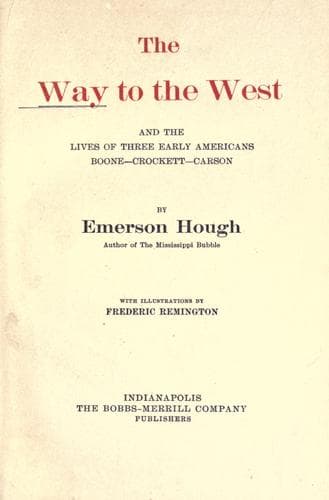
The Way to the West, and the Lives of Three Early Americans: Boone—Crockett—CarsonHough, Emerson
History
The Way to the West, and the Lives of Three Early Americans: Boone—Crockett—Carson
Hough, Emerson
Boone, Daniel, 1734-1820; Carson Kit, 1809-1868; Crockett, Davy, 1786-1836; Mississippi River Valley -- History; West (U.S.) -- History
This last argument had very much to do with the settlement of Kentucky.
Salt and lead were essentials. Salt was very heavy. The transportation
across these grim mountains was very difficult. If one could have salt
in Kentucky, it would not be necessary for one to come back. To-day we
can scarcely understand this reasoning, once so cogent.
To strengthen the grasp upon historical facts and dates it is sometimes
well to begin at the time close at hand, and go backward. We may
therefore make a reversed recapitulation of the explorations of
Kentucky, this dark and bloody hunting and fighting ground of many
tribes of strong-legged and peppery-headed savages.
In 1770 the “Long Hunters” of Joseph Drake and Henry Skaggs were in
Kentucky—indeed, ran across Daniel Boone there; yet Kentucky was then
an oldish land. In 1766 James Smith and five others explored much of
west Tennessee, and worked north as far as Illinois. The Virginian, John
McCullough, with one white companion, saw Kentucky in the summer of
1769, pushed on northward as far as the point where Terre Haute,
Indiana, now stands, and later descended the Mississippi River to New
Orleans. Uriah Stone took a party of twenty hunters over the Cumberland
Gap into Kentucky in the month of June, 1769, one month later than
Boone’s journey thither; but Stone had been in Kentucky in 1766.
George Washington was on the Ohio River in 1770 and 1767; John Finley in
1752; Christopher Gist in 1750; Doctor Thomas Walker in 1748; John Peter
Salling and John Howard, in 1742, we have noted. Before all these was
the French expedition of 1735. Indeed, just one hundred years before
Boone’s journey into Kentucky, John Lederer, a Virginian, crossed the
Alleghanies and fared westward for some distance; and ninety-nine years
previous to Boone’s first glimpse of the delectable land, Thomas Batts
and party had “taken possession” of the headwaters of the Great Kanawha
in the name of Charles II.
We therefore see, with what will be a certain surprise to the average
reader of American history, that Kentucky and the trans-Appalachian land
was not wholly unknown but indeed fairly well understood and accurately
forecast in possibilities, more than a generation before Daniel Boone
ever saw it. Where, then, is Boone’s fame as an explorer? Upon what does
his reputation as an adventurer rest? What claim had he to hold himself
as an “instrument for the settlement of the wilderness”?
The answer to all these doubts is read in the record of the holding of
Kentucky. It is found in the inefficacy of a “taking possession” by
means of the temporary planting of a flag and the empty claiming of a
territory extending from sea to sea. The flag of Boonesborough was
planted never to come down. The stockade of the homebuilders was
defended by an “unwavering fortitude.” Kentucky discovered Daniel Boone,
not Daniel Boone discovered Kentucky. Read it in this way and all shall
be plain.
Public-domain text, read in full here on John Shaqi.
Reviews
Reviews
No reviews yet
Be the first to share your thoughts on this work.
Elsewhere in the archive
Join the Discussion
Join the discussion
Sign in to leave a comment or review.
Sign InorCreate an account