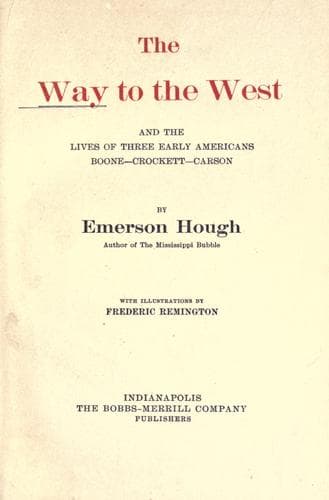
The Way to the West, and the Lives of Three Early Americans: Boone—Crockett—CarsonHough, Emerson
History
The Way to the West, and the Lives of Three Early Americans: Boone—Crockett—Carson
Hough, Emerson
Boone, Daniel, 1734-1820; Carson Kit, 1809-1868; Crockett, Davy, 1786-1836; Mississippi River Valley -- History; West (U.S.) -- History
Boone was the simpler and sincerer soul, the graver and more dignified
figure; Crockett the more magnetic personality, the more plausible, if
at times less candid, man. One man was practically as ignorant as the
other. Boone had no taste for political life, and his sole wish was to
live ever a little beyond that civilization of which he was the pioneer
and guide. Crockett, built also of good, common, human clay, for
two-thirds of his life seemed animated by no greater ambition.
Then all at once we see him turned politician. He succeeds, and his name
grows larger than his neighborhood and country. Not knowing the basis of
the tariff, ignorant of the text of the Constitution, master of the
practice, but unable to explain the theory, of a caucus or a town
meeting, he finds himself owner of a seat in the United States Congress,
fairly the central figure of that Congress, the cynosure not only of the
South but of the East and North.
He is at this time nothing but a great, good-humored boy, the very type
alike of an open-handed generosity, and an open-mouthed and sometimes
ill-timed levity. He is the product of political accident. Yet, wonder
of wonders, we find this man, quite past the time usually assigned as
the limit for the development and fixing of a man’s character, suddenly
blossoming out into a second development, a second manhood, more
thoughtful and more dignified than that of his early days. Without
education when he started for the halls of Congress, he gains that
education more rapidly than did ever man before.
Crockett returned to his home a graver and broader man. Even his speech
had gained freedom, ease and clarity, though still he delighted, perhaps
more in jest than otherwise, to bring in the crudities of expression,
the quips and quirks of that language through which he had, to his own
surprise and without his own plan, won his sudden notoriety—a notoriety
that was later to turn to fame.
There is not to be found in all the history of American statesmanship so
swift and sound a ripening into mature thought as that of this
backwoodsman, the first political “mugwump” or independent; who engaged
in politics for reasons of self-interest, and then all at once grew big
enough to set self-interest aside and to do what seemed to him wise and
right—a type of statesmanship now well-nigh defunct in America. And yet
we see him, in the pang of his first decisive political defeat, growing
bitter at his reverses, losing the genial philosophy of his earlier
years, even renouncing his country, and forthwith turning away from
family, friends and commonwealth to seek a new fortune in an alien land.
Public-domain text, read in full here on John Shaqi.
Reviews
Reviews
No reviews yet
Be the first to share your thoughts on this work.
Elsewhere in the archive
Join the Discussion
Join the discussion
Sign in to leave a comment or review.
Sign InorCreate an account