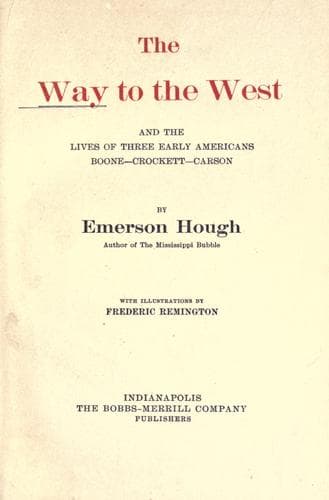
The Way to the West, and the Lives of Three Early Americans: Boone—Crockett—CarsonHough, Emerson
History
The Way to the West, and the Lives of Three Early Americans: Boone—Crockett—Carson
Hough, Emerson
Boone, Daniel, 1734-1820; Carson Kit, 1809-1868; Crockett, Davy, 1786-1836; Mississippi River Valley -- History; West (U.S.) -- History
Once across the Alleghanies the pathways had been pointed out by nature;
beyond the Mississippi these pathways were reversed. Man had not wings
like the wild bird. His pilgrimage must still be slow, his methods of
locomotion clumsy. The paths no longer lay even with the currents of the
streams. The adventurer into the West must, for the most part, follow
the reversed pathways of the waters. Briefly, the journey of the
frontiersman from Pennsylvania to the Mississippi was one of angles, the
first leg running to the southwest, thence northwest, thence southwest.
The pilgrimage profile from the Mississippi to the Rockies was equally
angular. The line of travel did not, for the most part, run directly to
the west. It angled out and upward, wherever water transportation led,
and where the streams showed the way.
In the story of Daniel Boone we have seen how he moved again and again,
seeking ever to edge a little farther to the west than his nearest
neighbors. Still another great frontiersman, Davy Crockett, beloved of
the American people, gives us instance of this patient progress of the
west-bound, halting, advancing, but never tiring. The life of Crockett
will afford in itself a good view of the profile of the population
movement, and will give as well a notion of the life and customs of
those early times.
Davy Crockett, backwoodsman and bear hunter, magistrate, legislator and
congressman; a man who at the time of his marriage scarcely knew one
letter of the alphabet from the other, yet at middle age was one of the
best-known figures of the American political world, and who was even
mentioned as a possibility for the presidency of the United States; a
man that lived like a savage and died like a hero—one of the uncouthest
gentlemen that ever breathed—such a man as this could have been the
product of none but an extraordinary day. We shall do well to note the
story of his life, for his is one of those colossal figures now rapidly
passing into the haze of forgetfulness or the mirage of mere conjecture.
In some fashion the names of Boone and Crockett are often loosely
connected. They were in part contemporaneous though not coincident.
Showing in common the rugged traits of the typical man of their time,
they were yet distinctly unlike in many qualities. A writer who knew
both men states that he considered Crockett the mental superior of
Boone. After weighing carefully all the evidence obtainable—and there
is much more information available concerning Crockett than in regard to
Boone—one would be disposed to differ from such an opinion.
Public-domain text, read in full here on John Shaqi.
Reviews
Reviews
No reviews yet
Be the first to share your thoughts on this work.
Elsewhere in the archive
Join the Discussion
Join the discussion
Sign in to leave a comment or review.
Sign InorCreate an account