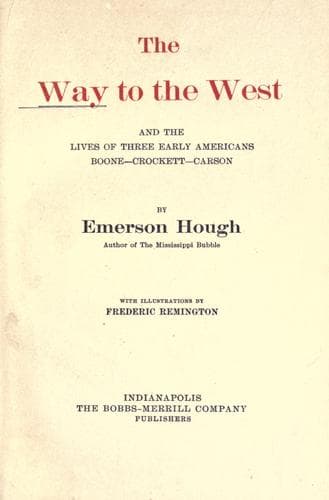
The Way to the West, and the Lives of Three Early Americans: Boone—Crockett—CarsonHough, Emerson
History
The Way to the West, and the Lives of Three Early Americans: Boone—Crockett—Carson
Hough, Emerson
Boone, Daniel, 1734-1820; Carson Kit, 1809-1868; Crockett, Davy, 1786-1836; Mississippi River Valley -- History; West (U.S.) -- History
Poor Davy spent two years in these wanderings, and was fifteen years old
when all at once he again dawned upon the paternal grounds in eastern
Tennessee. These two years had been spent in considerable physical
discomfort and anguish of spirit, and the journey home was accomplished
only after many dangers and difficulties. Crockett admits that at this
time he did not know the letters of the alphabet. His father, shiftless
as ever, had been lavish with his promissory notes. He offered Davy his
“freedom” if he would work six months for a neighbor to whom he had
given a note for forty dollars. Davy generously did so, and capped it
off by working another six months and taking up another one of his
father’s notes, for thirty-six dollars. This last he was not obliged to
do, yet in spite of these bitter surroundings, there had flowered in the
young savage’s heart a certain feeling of family honor.
Now all at once the boy backwoodsman became conscious of his own
infirmities. He went to school six months, the only schooling he ever
had in his life. He learned to write his name, to spell to some extent,
to perform a few simple sums in arithmetic. Twice blighted in love at
eighteen years of age, he married a pretty little Irish girl, a daughter
of a neighboring family. “I know’d I would get her,” says he, “if no one
else did before next Thursday.”
Crockett was married in his moccasins, leggings and hunting shirt. His
bride was dressed in linsey-woolsey. There was no jewelry. The table on
which the wedding feast was spread was made of a single slab. The
platters were of wood, the spoons of pewter and of horn. In his own
abode, as he first entered it, there was no bed and not a chair, a knife
or a fork. Yet, after the expenditure of fifteen dollars, which he
borrowed, Crockett and his wife “fixed the place up pretty grand,” and
found it good enough for them for some years. Here two boys were born to
them.
At the ripe age of twenty years, that is to say in the year 1806,
Crockett considered it necessary for the betterment of his fortunes that
he should remove farther toward the West, this having been the universal
practice of his kind. He journeyed for four hundred miles through the
Western wilderness, taking his family and household goods with him.
Their transportation, as we are advised, consisted of one old horse and
two colts. These animals were packed with the household goods. In the
wild journey down the Holston the family, children and all, camped out,
enduring the weather as best they might. At last they came to a halt on
Mulberry Creek, in Lincoln County, in what they took to be the Promised
Land. The soil was generously rich, game and fish were abundant, the
climate was all that could be asked. Crockett built him a cabin, and
here he lived for two years, much as he had lived in eastern Tennessee.
Then, in the easy fashion of the time, he moved once more, this time
settling in Franklin County, on Bear Creek, still in the wilderness.
Public-domain text, read in full here on John Shaqi.
Reviews
Reviews
No reviews yet
Be the first to share your thoughts on this work.
Elsewhere in the archive
Join the Discussion
Join the discussion
Sign in to leave a comment or review.
Sign InorCreate an account