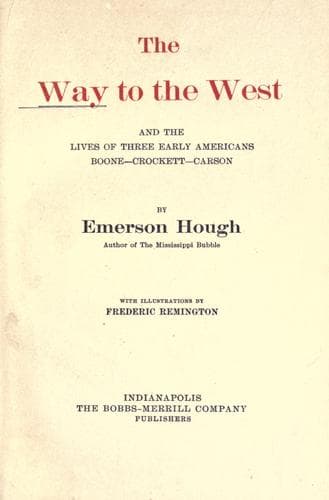
The Way to the West, and the Lives of Three Early Americans: Boone—Crockett—CarsonHough, Emerson
History
The Way to the West, and the Lives of Three Early Americans: Boone—Crockett—Carson
Hough, Emerson
Boone, Daniel, 1734-1820; Carson Kit, 1809-1868; Crockett, Davy, 1786-1836; Mississippi River Valley -- History; West (U.S.) -- History
Here we find him living in 1813, at which time the call went out for
volunteers to serve in the Creek War under General Jackson. Without much
ado, Crockett said good-by to his family, joining those wild irregular
troops who, amid countless hardships, plodded up and down the region of
Alabama and Georgia, meeting the southern Indians, destroying them
wholesale or piecemeal as the case might be. Crockett marched,
counter-marched, acted as spy and hunter, doing his full share of the
work.
All the time he was rising in the esteem of his fellow men. He was now a
tall, large-boned, muscular man. His hair, we are told, was sandy, his
eyes blue, his nose straight, his mouth wide and merry; and so we see
Davy Crockett the grown man. Never having known anything but hardship
all his life, he has none the less never known anything but cheerfulness
and content. The apt jest and catching story are always ready on his
lips. He is the life of the camp-fire. Gradually he forges to the front.
The qualities of leadership begin to appear.
In all these rude military experiences, although Crockett does not fancy
the revolting scenes which in some instances he witnesses at the Indian
killings, he shows the ardent nature, the fighting soul. Hence he
respects the fighting man and pays his obedience to General Jackson.
There is no hint of that fatal falling out between the two men that
later is so suddenly to terminate Crockett’s ambitions.
In 1822, after his return from this petty war, Crockett’s fortunes once
more needed mending, and the remedy, of course, was to move again. He
had previously explored nearly all of Alabama, and later investigated
southern Tennessee, finally locating on Shoal Creek, in Giles County.
Crockett’s faithful wife, the little Irish woman, had died, and he, ever
ready to console himself, now married a widow of the neighborhood, an
estimable woman, who added two children to his already growing family.
This second wife appears to have been a dignified and able woman. Little
is known of her, and she seems to have lived the life of the average
frontier woman, patiently and uncomplainingly following her lord and
master in all his enterprises and his wanderings. Two pack-horses still
served to transport all the family goods on this latest journey.
The greed for land had rapidly sent a turbulent population into the
Cherokee country of the “New Purchase” where Crockett now resided, and
among these lawless souls restrictions were needed, although the country
knew no law and had no courts. Crockett was elected judge, without any
commission and without any formal process of law. He served wisely, and
although unable to write a warrant, he sometimes issued verbal warrants.
He claimed that his decisions were always just and that they “stuck like
wax.”
Public-domain text, read in full here on John Shaqi.
Reviews
Reviews
No reviews yet
Be the first to share your thoughts on this work.
Elsewhere in the archive
Join the Discussion
Join the discussion
Sign in to leave a comment or review.
Sign InorCreate an account