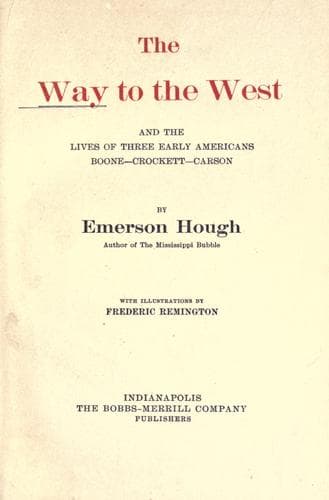
The Way to the West, and the Lives of Three Early Americans: Boone—Crockett—CarsonHough, Emerson
History
The Way to the West, and the Lives of Three Early Americans: Boone—Crockett—Carson
Hough, Emerson
Boone, Daniel, 1734-1820; Carson Kit, 1809-1868; Crockett, Davy, 1786-1836; Mississippi River Valley -- History; West (U.S.) -- History
“I had taken old Betsy,” says he, referring to his rifle, “and straggled
off to the banks of the Mississippi River, and meeting no game, I didn’t
like it. I felt mighty wolfish about the head and ears, and thought I’d
spile if I wasn’t kivvered in salt, for I hadn’t had a fight in ten
days. I cum acrost a fellow who was floatin’ down-stream, settin’ in the
stern of his boat, fast asleep. Said I, ‘Hello, stranger, if you don’t
take care your boat will get away from you;’ and he looked up and said
he, ‘I don’t value you.’ He looked up at me slantendicular, and I looked
down at him slantendicular; and he took a chaw of turbaccur, and said
he, ‘I don’t value you that much.’ Said I, ‘Come ashore. I can whip you.
I’ve been tryin’ to get a fight all the mornin’;’ and the varmint
flapped his wings like a chicken. I ris up, shook my mane, and neighed
like a horse.
“He run his boat plump head foremost ashore. I stood still and sot my
triggers—that is, I took off my shirt, and tied my gallusses tight
around my waist—and at it we went. He was a right smart ’coon, but
hardly a bait fer a feller like me. I put it to him mighty droll. In ten
minutes he yelled enough, and swore I was a ripstaver. Said I, ‘Ain’t I
the yaller flower of the forest? I’m all brimstone but the head and
ears, and that’s aquafortis.’ Said he, ‘You’re a beauty, and if I know’d
yore name I’d vote for you next election.’ Said I, ‘I’m that same Davy
Crockett. You know what I am made of. I’ve got the closest shootin’
rifle, the best ’coon dog, the biggest bear tickler and the ruffest
rackin’ horse in the district. I can kill more likker, cool out more
men, and fool more varmints than any man you can find in all Tennessee!’
Said he, ‘Good morning, stranger, I’m satisfied.’ Said I, ‘Good morning,
sir; I feel much better since our meeting—don’t forget about that
vote.’”
Congressmen to-day do not employ language quite so picturesque, or
methods of vote-getting quite so crude. The story is a trifle
apochryphal; yet Crockett himself, in what is called his autobiography,
a work which he no doubt dictated, or at least authorized, gives the
following account of one of his speeches to a stranger, at Raleigh,
while Crockett was en route to Washington to take his first seat in
Congress.
Public-domain text, read in full here on John Shaqi.
Reviews
Reviews
No reviews yet
Be the first to share your thoughts on this work.
Elsewhere in the archive
Join the Discussion
Join the discussion
Sign in to leave a comment or review.
Sign InorCreate an account