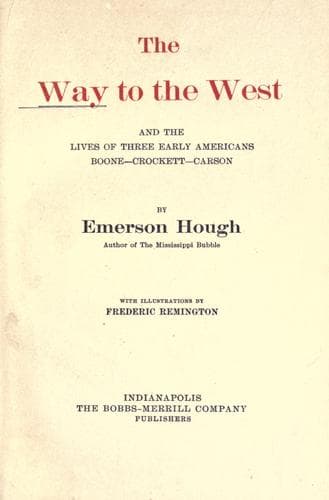
The Way to the West, and the Lives of Three Early Americans: Boone—Crockett—CarsonHough, Emerson
History
The Way to the West, and the Lives of Three Early Americans: Boone—Crockett—Carson
Hough, Emerson
Boone, Daniel, 1734-1820; Carson Kit, 1809-1868; Crockett, Davy, 1786-1836; Mississippi River Valley -- History; West (U.S.) -- History
Mr. J. S. C. Abbott, in his biography of Crockett, writes of his station
at this time: “Most men, most women, gazing upon a scene so wild, lonely
and cheerless, would say, ‘Let me sink into the grave rather than be
doomed to such a home as this.’” Such is the point of view of the narrow
observer that never knew his America. Not so Davy Crockett. He did not
find this region lonely or cheerless. On the contrary, we find him
fraternizing with the rude boatmen from points lower down on the
Mississippi River, and making himself very comfortable. Presently he
goes back after his family, bringing them on to his new home in October
of that year. They and their belongings are transported by two horses,
this limited cavalcade being still sufficient to carry all the worldly
belongings of David Crockett, hunter, warrior, magistrate and
legislator. Davy is still poor, but he does not wish to “sink into the
grave.” On the contrary, as he journeys along the wild woodland path he
sings, jests and whistles, happy as the birds about him, content among
the sweet mysteries of the untracked forests. He is the product of wild
nature, as savage as the most savage, a man primeval, unfettered, free.
He is the new man, the man of the west, the new-American.
As an example of Crockett’s early electioneering methods, we may cite
his procedure in his first canvass for the legislature. He says:
“I didn’t know what the government was. I didn’t know but General
Jackson was the government;” a statement not wholly the product of
sarcasm. He met Colonel Polk, later President Polk, and according to his
own story the colonel remarked:
“It is possible we may have some changes in the judiciary.”
“Very likely,” replied Davy, “very likely,” and discreetly withdrew.
“Well,” he comments, “if I know’d what he meant by ‘judiciary,’ I wish I
may be shot. I never heard there was such a thing in all nature.”
Yet another electioneering story attributed to Crockett, perhaps
authentic as many of those told regarding him, shows well enough the
rude temper of his region, if we do not go further, and accord to it a
certain hint of that native humor that was later to see its growth in
America.
Public-domain text, read in full here on John Shaqi.
Reviews
Reviews
No reviews yet
Be the first to share your thoughts on this work.
Elsewhere in the archive
Join the Discussion
Join the discussion
Sign in to leave a comment or review.
Sign InorCreate an account