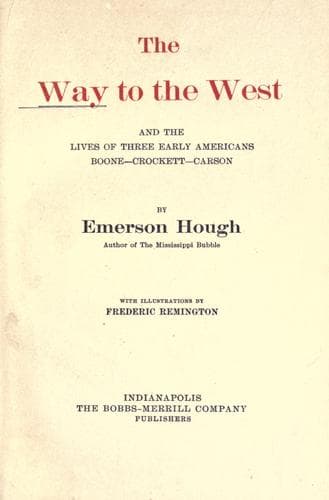
The Way to the West, and the Lives of Three Early Americans: Boone—Crockett—CarsonHough, Emerson
History
The Way to the West, and the Lives of Three Early Americans: Boone—Crockett—Carson
Hough, Emerson
Boone, Daniel, 1734-1820; Carson Kit, 1809-1868; Crockett, Davy, 1786-1836; Mississippi River Valley -- History; West (U.S.) -- History
It is at this stage of his career that we may speak of the birth of the
second or real David Crockett. These wild surroundings have now begotten
in him a rugged sense of self-reliance and a personal independence that
henceforth manifest themselves unmistakably. He is a politician, but an
independent politician. “I would as soon be a ’coon dog as to be obliged
to do what any man or set of men told me to do,” he says. “I will pledge
myself to support no administration.” “I would rather be politically
dead than hypocritically immortalized,” he declares; and in yet another
instance he says that he “will not submit to the party gee-whoa-haw;”
that he will be “no man’s man, and no party’s man.”
In spite of all these personal dicta he is elected. His election costs
one hundred and fifty dollars, all in borrowed money. It costs David
Crockett, congressman, an additional one hundred dollars, also borrowed,
to get to the national Capitol at Washington, where he arrives perhaps
the most unique specimen of Congressman ever produced in this broad land
of ours. His first act is to pay his debts—which not all Congressmen
since then have done so promptly. It is hard for the backwoods
congressman at Washington, yet he has good sense, good tact, good-nature
and a magnetic temperament. His motto, “Be sure you are right, then go
ahead,” wins for him sudden fame. Perhaps it is fame too sudden. Now we
must bid good-by to Davy Crockett, bear hunter. He is bitten of the
fatal poison of political ambition. From this time on the record of his
life is for a while public, plain and well known.
Crockett was a Southerner and, as has been stated, at first a friend of
the Jacksonian Democracy. Naturally he should have been expected to
prove loyal to the doctrines of the South, and the South at that time
was held in the hollow of Old Hickory’s hand. Note now a sudden
sternness of fiber in the bear hunter’s character that entitles him to a
better name than that of time-serving politician. As a matter of
conviction and principle he differs from the autocratic leader then
sitting in the president’s chair. He opposes President Jackson’s Indian
bill, and the proposition to withdraw the deposits from the United
States banks. Indeed, instead of being a follower of Jackson, he comes
out boldly as an opponent of his former leader.
Public-domain text, read in full here on John Shaqi.
Reviews
Reviews
No reviews yet
Be the first to share your thoughts on this work.
Elsewhere in the archive
Join the Discussion
Join the discussion
Sign in to leave a comment or review.
Sign InorCreate an account