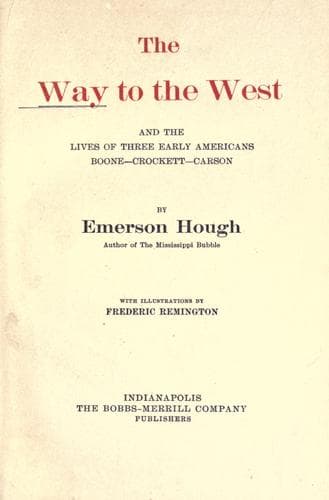
The Way to the West, and the Lives of Three Early Americans: Boone—Crockett—CarsonHough, Emerson
History
The Way to the West, and the Lives of Three Early Americans: Boone—Crockett—Carson
Hough, Emerson
Boone, Daniel, 1734-1820; Carson Kit, 1809-1868; Crockett, Davy, 1786-1836; Mississippi River Valley -- History; West (U.S.) -- History
The North hails him joyously as a Southerner with a Whig heart. Let Davy
make the most of it; none the less he loses the next contest for
Congress in his district. Yet he fights again, gets the nomination for
the next term, wins once more and hastens rapidly toward the height of a
national popularity. Realizing his own ignorance of the North and East,
in 1834 he undertakes a journey to those sections. At Baltimore he sees
a railroad for the first time in his life, and witnesses the tremendous
feat of seventeen miles made by a railway train in the time of
fifty-five minutes! At Philadelphia crowds meet him at the wharf and
cheer him to the echo. He is banqueted repeatedly, wined and dined times
without number, and made the recipient of countless attentions. The
young Whigs of Philadelphia come close to his heart when they make him a
present of a fine rifle, the very rifle that took the place of “Old
Betsy” and was with Crockett in his last fight at the Alamo.
In New York, in Boston and the larger manufacturing towns of
Massachusetts, Crockett repeats his Philadelphia triumphs. He is now a
national figure. His sayings and doings are quoted throughout the land.
If his Northern speeches are correctly reported, he has at this time
suddenly become the possessor of an easy and not undignified oratorical
style, though all his speeches are still well sprinkled with quaint
epigrams and homely illustrations.
We see in the Crockett of 1834 a figure not approached by any other
American statesman so nearly as by that other rugged Westerner, Abraham
Lincoln. These crude, virile, tremendous, human men, product of the
soil, born of the hard ground and the blue sky—how they do appeal, how
they do grow, how they do succeed.
Crockett is asked to visit Harvard College, but refuses for quaint
reasons of his own. Andrew Jackson has been made an LL. D. by Harvard,
and Crockett says that “one LL. D. is enough for Tennessee.” He is the
guest of Lieutenant-governor Armstrong, and chronicles naïve surprise
that Mr. Armstrong “did not charge him anything,” for entertaining him.
He states that in New England he found “more liberality than the Yankee
generally gets credit for.” He expresses his gratitude for the kindly
reception accorded him in New England and chronicles his admiration for
the thrift and industry of that country, which seems to have made a
vivid impression on his mind, different as these scenes were from the
wild surroundings in which he himself had grown up.
This trip into the North wrought epochal change for our bear hunter. He
learns now about the tariff, studies and approves the doctrines of
protection—rank heresy for a Southerner. Deep water for Davy now! He
seems to have had no counsel of prudence, for now he loses no
opportunity to chronicle his animosity toward General Jackson.
Public-domain text, read in full here on John Shaqi.
Reviews
Reviews
No reviews yet
Be the first to share your thoughts on this work.
Elsewhere in the archive
Join the Discussion
Join the discussion
Sign in to leave a comment or review.
Sign InorCreate an account