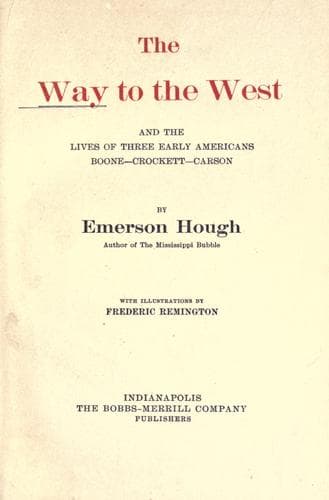
The Way to the West, and the Lives of Three Early Americans: Boone—Crockett—CarsonHough, Emerson
History
The Way to the West, and the Lives of Three Early Americans: Boone—Crockett—Carson
Hough, Emerson
Boone, Daniel, 1734-1820; Carson Kit, 1809-1868; Crockett, Davy, 1786-1836; Mississippi River Valley -- History; West (U.S.) -- History
New cities began to be heard of in this mountain trade, just as there
had been in the wagon days of the overland trail to Santa Fé: Pueblo,
Cañon City, Denver. All were outfitting and freighting points in turn,
while from the other side of the range there were as many
towns,—Florence, Walla Walla, Portland,—which sent out the long trains
of laden mules and horses. The pack-train was as common and as useful as
the stage-line in developing the Black Hills region, and many another
still less accessible.
Commonly a horse or a mule would carry two hundred to three hundred
pounds of freight, a burro one hundred to two hundred, and the price for
packing averaged somewhere about five to ten cents a pound per hundred
miles of distance, often very much more. It was astonishing what
flexibility this old system of carriage had. A good pack-master would
undertake to transport any article that might be demanded at the end of
his route. It is well known that much heavy mining machinery was packed
into the mountains; but this was not really very wonderful, for such
machinery was made purposely in suitable sections for such transport.
Somewhat more difficult were other articles, such as cook-stoves and the
like, shipped not “knocked down.” A piano was one of the odd articles
that went into the earliest of the Cœur d’Alene mining camps more than a
score of years ago. It was packed on four mules, the piano resting on a
sling of poles, which virtually bound the mules together as well as gave
support to their burden, two mules going in front and two behind. When
the animals became too tired to climb farther, the weight was
temporarily lightened by resting the piano on forked sticks thrust up
beneath the load. The strange package was taken through in safety,
though at a cost of about a thousand dollars. All sorts of articles were
shipped in the same fashion, and packages of glassware, cases of eggs,
and many such goods customarily made the long and rough journeys in
safety.
The charges were made on the weight of the package, including the case
or cover in which it was shipped, and it was poor policy on the part of
the shipper to pack his goods too flimsily, for the grip of the “diamond
hitch” was never a sparer of things beneath it. The hardest article to
pack in the mountains was quicksilver. This commodity was shipped in
iron flasks, and the first thing the packer did was to unscrew the tops
of these flasks and fill the remaining interior space completely with
water, in order to prevent the heavy blow of the shifting liquid
contents, which was distressing to the pack-horse. A flask of
quicksilver weighed about ninety pounds, and it was customary to pack
two flasks on each side of a horse or mule, each pair of flasks being
fastened in a board frame, which gave facility for lashing all fast, and
prevented the wear of the condensed weight against the back of the
animal.
Public-domain text, read in full here on John Shaqi.
Reviews
Reviews
No reviews yet
Be the first to share your thoughts on this work.
Elsewhere in the archive
Join the Discussion
Join the discussion
Sign in to leave a comment or review.
Sign InorCreate an account