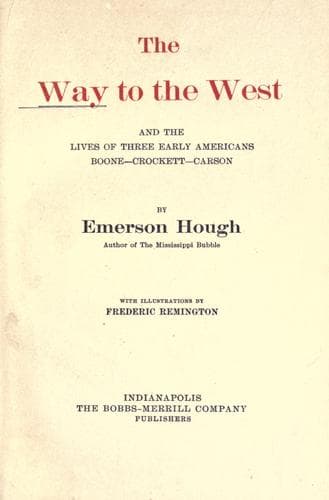
The Way to the West, and the Lives of Three Early Americans: Boone—Crockett—CarsonHough, Emerson
History
The Way to the West, and the Lives of Three Early Americans: Boone—Crockett—Carson
Hough, Emerson
Boone, Daniel, 1734-1820; Carson Kit, 1809-1868; Crockett, Davy, 1786-1836; Mississippi River Valley -- History; West (U.S.) -- History
The trapper that started out into the mountains might take only two or
three extra horses. He did not use more than half a dozen traps in those
days, and counted always upon living upon wild game. The new population
of the mining camps, which spread all through the mountains with
incredible rapidity, was made up of an entirely different class of men,
and was surrounded by an environment less bountiful. They did not come
to hunt, but to dig or to riot; and they must be fed. At this time the
necessity brought forth the man. It was the American packer that now
saved the day.
The pack-horse idea is as old as America, but in its perfection it is
the product of the Spanish Southwest. We read in history of the
progresses of royal personages in ancient times in the Old World, where
frequent mention is made of the number of sumpter-mules that attended
the caravans in those roadless days. The sumpter-mule was the forerunner
of the pack-mule, though it is to be doubted if any servant of an
old-time king ever learned to do such impossible things with the
sumpter-mule as the American packer did as a matter of course with his
beasts of burden.
Gradual changes were taking place, about midway of the last century, in
the characteristics of Western commerce. The trapper and the hunter had
trafficked as individuals. The Santa Fé trade was in control of men who
remained at home and sent their goods into another country, just as did
the early Phenician merchants. In the trade of the mining towns, the
merchant had come to be a resident and not a non-resident, and the
transportation of his supplies was in the hands of companies or
individuals who had not any ownership in the goods they handled.
The greatest drama of the common carrier had its scene in the Rocky
Mountains. The price of staples in any mountain town was something that
not even the merchant himself could predict in advance, dependent as it
was upon the thousand contingencies of freighting in rude regions and
among hostile tribes. Prices that would stagger the consumer of to-day
were frequently paid for the simplest necessaries. As in the days of the
trappers’ rendezvous everything was sold by the pint, so now the
standard of measure became the pound. A common price for sugar in a
mining camp was thirty-five to fifty cents a pound. In the San Juan
mining camps, as late as 1875, potatoes sold for twenty-five cents a
pound. A mule or burro would earn its own cost in a single trip, for
there were occasions under certain conditions, such as the packing from
Florence into the more remote placer districts, when the pack-master
charged as much as eighty cents a pound from the supply point to the
camps.
Public-domain text, read in full here on John Shaqi.
Reviews
Reviews
No reviews yet
Be the first to share your thoughts on this work.
Elsewhere in the archive
Join the Discussion
Join the discussion
Sign in to leave a comment or review.
Sign InorCreate an account