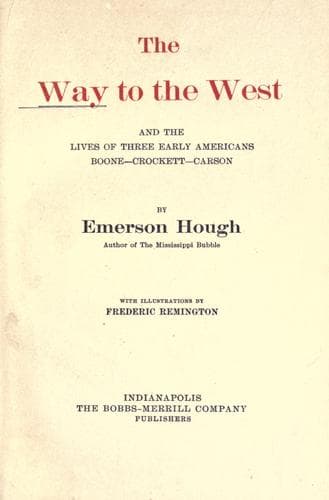
The Way to the West, and the Lives of Three Early Americans: Boone—Crockett—CarsonHough, Emerson
History
The Way to the West, and the Lives of Three Early Americans: Boone—Crockett—Carson
Hough, Emerson
Boone, Daniel, 1734-1820; Carson Kit, 1809-1868; Crockett, Davy, 1786-1836; Mississippi River Valley -- History; West (U.S.) -- History
We should find it difficult now to return to stage-coach travel, yet in
its time it was thought luxurious. One of the United States bank
examiners of that time, whose duties took him into the Western regions,
in the course of fourteen years traveled over seventy-four thousand
miles by stage-coach alone. It is the strange part of this vivid history
of the West that many men who were prominent and active in its wildest
and crudest days are living to-day, fully adapted to the present
conditions, and apparently almost forgetful that there ever was a
different time. Thus one of the more prominent early wagon-train
freighters of Montana, now a prosperous banker of his state, gives a
brief description of the old-time industry, which is interesting because
at first hand. The freighter-banker goes on to say:
“The wagons were large prairie schooners, usually three or four trailed
together, pulled by sixteen to twenty head of the largest oxen you ever
saw. It cost one cent a pound per one hundred miles to transport
freight. Sometimes, of course, we would get five times this. The danger
was from Indians (Sioux and Blackfeet) attacking the trains and the
drivers. The herders and wagon boss went armed. The earliest freighting
point was from Fort Benton, Montana, to the mines in the Rockies.[25]
When boats failed to reach Benton, owing to low water, then the teams
went below, three to four hundred miles, to haul the freight up. In
later times (after the junction of the Union Pacific and Central Pacific
Railways) we transported freight from Corinne, Utah. There were probably
one million dollars invested by individuals and companies in Montana.
The largest companies were the ‘Diamond R’ Transportation Company,
established by Colonel Charles A. Broadwater and three others, and I. G.
Baker & Company. The latter company was owned and managed by the writer,
and in the summer of 1879 transported over twenty million pounds of
freight on wagons for the United States government, Canadian government,
and the merchants of Montana.”
A study of the market reports of the old “Montana Post,” published 1864
to 1868, affords much insight into the life and conditions of that time.
Commenting upon these facts, our early western resident, Mr. N. P.
Langford, remarks:
“The high prices of merchandise in Montana were the natural outcome of
great cost of transportation, combined with large profits, owing to the
great risks incurred in taking goods through a hostile Indian country.
As population increased, the necessity of procuring from the states a
sure supply of the necessities of life was uppermost in the minds of the
people. With the fortune of Midas, they feared soon to share his fate,
and have nothing but gold to eat. But there was no lack of adventurous
traders in the states, who were ready to incur the risks incident to a
long overland journey, whose successful termination was certain greatly
to enrich them.[26]
Public-domain text, read in full here on John Shaqi.
Reviews
Reviews
No reviews yet
Be the first to share your thoughts on this work.
Elsewhere in the archive
Join the Discussion
Join the discussion
Sign in to leave a comment or review.
Sign InorCreate an account