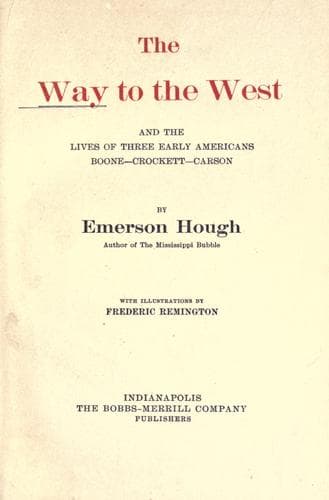
The Way to the West, and the Lives of Three Early Americans: Boone—Crockett—CarsonHough, Emerson
History
The Way to the West, and the Lives of Three Early Americans: Boone—Crockett—Carson
Hough, Emerson
Boone, Daniel, 1734-1820; Carson Kit, 1809-1868; Crockett, Davy, 1786-1836; Mississippi River Valley -- History; West (U.S.) -- History
“The supplies were brought into the mining camps of Montana by three
different routes: the overland route from Omaha or St. Joseph, Missouri,
by way of Denver and Salt Lake, a distance of nineteen hundred miles;
from St. Louis by way of the Missouri river to Fort Benton; and by
pack-train from the Pacific slope, starting from Portland or Walla
Walla, Oregon, crossing the Cœur d’Alenes and the main ranges of the
Rockies, and coming over the Bitter Root valley.
“The larger part of the merchandise brought to Montana came by the
first-named route. The vehicles used in transportation were, for the
most part, what were known as ‘Murphy wagons’—vehicles with large
wheels and strong bodies, capable of holding eight thousand pounds of
general merchandise, and drawn by five or six yoke of oxen, or by as
many spans of mules. During the rainy season, and for many weeks after a
storm, it was frequently the case that not more than five miles a day of
progress could be made with such a wagon train over the alkali plains or
along the valley of such a stream as Bitter Creek. An average journey
was about one hundred miles a week, and thus an entire season,
commencing at the time when the grass of the plains was sufficiently
grown to furnish food for oxen and mules, and lasting from eighteen to
twenty weeks, was consumed in making the journey.
“One who has never seen the plains, rivers, rocks, cañons, and mountains
of the portion of the country traversed by these caravans, can form but
a faint idea from any description given of them of the innumerable and
formidable difficulties with which every mile of this weary march was
encumbered. History has assigned a foremost place among its glorified
deeds to the passage of the Alps by Napoleon, and to the long and
discouraging march of the French army under the same great conqueror to
Russia. If it be not invidious to compare small things with great, we
may assuredly claim for these early pioneers greater conquests over
nature than were made by either of the great military expeditions of
Napoleon. A successful completion of the journey was simply an escape
from death.”
The nature of the transportation of passengers over the overland route
may be inferred from a trip once made by the above writer by stage from
Atchison, on the Missouri River, to Helena, Montana, which is thus
described:
Public-domain text, read in full here on John Shaqi.
Reviews
Reviews
No reviews yet
Be the first to share your thoughts on this work.
Elsewhere in the archive
Join the Discussion
Join the discussion
Sign in to leave a comment or review.
Sign InorCreate an account