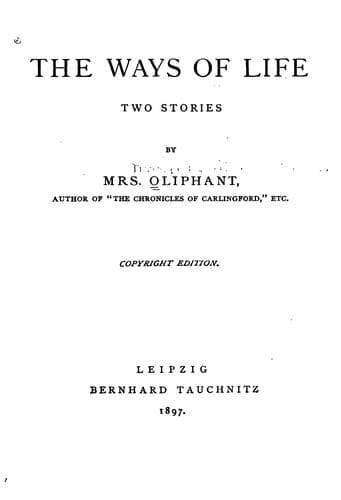
The Ways of Life: Two StoriesOliphant, Mrs. (Margaret)
General
The Ways of Life: Two Stories
Oliphant, Mrs. (Margaret)
Fiction
“So long as he doesn’t leave out anything, either h’s or 0’s, in his
cheque.”
Mr. Sandford felt slightly, unreasonably offended by any reference to
the cheque. He gave it to his wife to send to the bank, with an annoyed
apprehension that she would make some remark upon the fifty guineas
which were left out. But Mrs. Sandford had not been his wife for thirty
years without being able to read the annoyance in his face. And though
she did not know what was its cause she respected it, and said not a
word about the difference which her quick eye saw at once. Could it be
that which had vexed Edward? she asked herself--he was not usually a man
who counted his pounds in that way.
The sending off of the “Black Prince,” its packing and directing, and
all the details of its departure, occupied him for some time. It was
August, the beginning of holiday time, when, though never without a
protest at the loss of the light days, even a painter idles a little.
And the youngest boy had come from school, and they were all going to
the seaside. Mr. Sandford did not like the bustle of the moment. He
proposed to stay in town for a few days after the family, and join them
when they had settled down in their new quarters. Before they went,
however, he had an interview with one of those friends of Jack’s who
were always about the house, and whose opinions on art were so different
from Mr. Sandford’s, which gave another touch of excitement to the
household. The young fellow wanted to marry Lizzie, as had been a long
time apparent to everybody but her father. There was nothing to be said
against him except that he had not much money; but Mr. Sandford thought
that young Moulton looked startled when he had to inform him that Lizzie
would have no fortune. “Of course that was not of the least
consequence,” he said, but he gave his future father-in-law a curious
and startled look.
“I think he was disappointed that there was no money,” the painter said
afterwards to his wife.
“Oh, Edward! there is nothing mercenary about him!” said Mrs. Sandford;
but she sighed and added, “If there only had been a little for her--just
enough for her clothes. It makes such a difference to a young married
woman. It is hard to have to ask your husband for everything.”
“Did you think so, Mary?” he asked, with a smile but a sense of pain.
“I--but we were not like ordinary people, we were just two fools
together,” said the wife, with a smile which brightened all her face;
“but,” she added, shaking her head, “we don’t marry our daughters like
that.”
“If she is half as good to him as you have been to me----”
“Oh, don’t speak,” she said, putting up her hand to stop his mouth.
“Lance Moulton can never be the hundredth part so good as _my_ husband.”
But she stopped after this little outburst, and laughed, and again
shaking her head, repeated, “But we don’t marry our daughters like
that.”
He felt inclined to ask, but did not, why?
Public-domain text, read in full here on John Shaqi.
Reviews
Reviews
No reviews yet
Be the first to share your thoughts on this work.
Join the Discussion
Join the discussion
Sign in to leave a comment or review.
Sign InorCreate an account