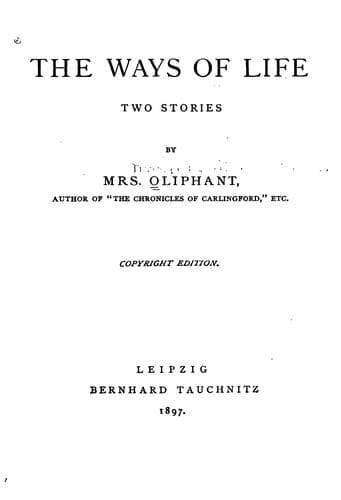
The Ways of Life: Two StoriesOliphant, Mrs. (Margaret)
General
The Ways of Life: Two Stories
Oliphant, Mrs. (Margaret)
Fiction
He had never thought urgently of that necessity. So long as there is
nothing pressing about it, no appearance of its approach, it is easy
enough to speak of that conclusion. Sometimes there is even a pensive
pleasure in it. “When I am out of the way,” “When our day is over,” are
things quite simple to say. For of course that must come one time or
another, as everybody knows. It is more serious, but still not anything
very bad, to speak now and then of what is to be done “if anything
happens.” These things make but little impression upon the mind, even
when old age is on its way. And Mr. Sandford at sixty had as yet felt
very few premonitions of old age. He had called himself an old man with
a laugh, for his eye was not dim, nor his natural force abated; and it
was still pleasantly absurd to think that he could be supposed an old
man. But now all this took a different aspect. He felt no older, indeed,
but his position was altogether changed. In the shock of his new
circumstances he stood helpless, not knowing how to meet this unfeared,
unthought-of contingency. But his mind went off with a spring to further
eventualities. The only comfort was this, they had a thousand pounds
apiece laid up for them. But it would be necessary first that he should
die.
Thinking it all over, he thought, on the whole, that this was the best
thing that could happen. The changes which he surveyed with such a sense
of impossibility, not knowing how they could be brought about, would
become quite natural if he died. There was always a change on the death
of the father. It was the natural time for remodelling life, for
altering everything. The family would not be able, of course, to remain
in this house, to keep up their present superstructure of existence: but
then in the change of circumstances that would seem quite natural and
they would not feel it. They could put everything, then, upon a simpler
footing. And they would have an income, not much of an income, perhaps,
but yet something that would come in punctually to the day, and which
would be independent of anything they did, which would have nothing to
do with picture dealers or patrons of art, or the changes of taste that
affected them. What a thing that was, when one came to think of it, to
have an income--something which came in all the same whether you worked
or not, whether you were ill or well, whether you were in a good vein
and could get on with your picture, or whether it dragged and did not
satisfy you! It gave him a sensation of pleasure to think of it: but
then he reflected on the one preliminary which was not so easy to bring
about, which no planning of his could accomplish just when it was
wanted, just when it would be of most use.
Public-domain text, read in full here on John Shaqi.
Reviews
Reviews
No reviews yet
Be the first to share your thoughts on this work.
Join the Discussion
Join the discussion
Sign in to leave a comment or review.
Sign InorCreate an account