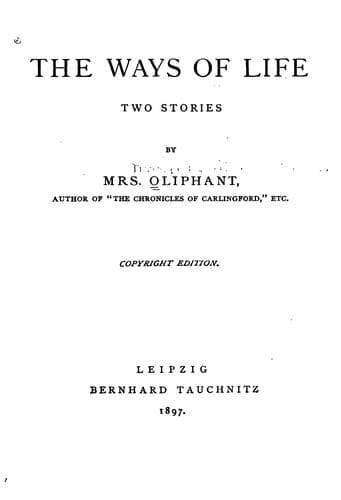
The Ways of Life: Two StoriesOliphant, Mrs. (Margaret)
General
The Ways of Life: Two Stories
Oliphant, Mrs. (Margaret)
Fiction
“Poor boy! You know he would give his little finger to have anything to
do. He has nothing to do. How can he help that? When we go back to town
you must really put your shoulder to the wheel. Among all your friends
surely, surely, something could be got for Harry,” said his mother, thus
turning the tables. “And in the meantime,” she added, “to get all the
health he can, and the full good of the sea, is certainly the best thing
the poor fellow could do.”
What answer could be made to this? Mr. Sandford went out for his
walk--that long silent walk, in which the great Consoler came down from
amid all the silvery lights and shining skies, and walked with him in
the freshness of the morning, all silent in tenderness and great
solemnity and awe.
CHAPTER VI.
“Unless, by the grace of God, something should happen”--that was what he
kept saying to himself when he reflected on the disclosure which must be
made when the seaside season was over. The great events of life rarely
happen according to our will. A man cannot die when he wishes it, though
there should be every argument in favour of such an event, and its
advantages most palpable. The moment passes in which that conclusion
would have all the force and satisfactory character of a great tragedy,
and a dreary postscript of existence drivels on, destructive of all
dignity and appropriateness. We live when we should do much better to
die, and we die sometimes when every circumstance calls upon us to live.
Most people will think that it was a very dreary hope that moved Mr.
Sandford’s mind--perhaps even that it was not the expedient of a brave
man to desire to leave his wife and children to endure the change and
the struggle from which he shrank in his own person. But this was not
how it appeared to him. He thought, and with some reason, that the
change which becomes inevitable on the death of the head of a house is
without humiliation, without the pang of downfall which would be
involved in an entire reversal of life which had not that excuse; he
thought that everybody who knew him would regret the change, and that
every effort would be made to help those who were left behind. It would
be no shame to them to accept that help; it would seem to them a tribute
to his position rather than pity for them. His wife would believe that
her husband, a great painter, one of the first of the day, had fully
earned that recognition, and would be proud of the pension or the money
raised for her as of a monument in his honour. And then the insurances.
There could be no doubt, he said to himself, with a rueful smile, that
so much substantial money would be much better to have than a man who
could earn nothing, who had become incapable, whose work nobody wanted.
He had no doubt whatever that it would be by far the best solution. It
would rouse the boys by a sharp and unmistakable necessity; it might, he
thought, be the making of the boys, who had no fault in particular
Public-domain text, read in full here on John Shaqi.
Reviews
Reviews
No reviews yet
Be the first to share your thoughts on this work.
Join the Discussion
Join the discussion
Sign in to leave a comment or review.
Sign InorCreate an account