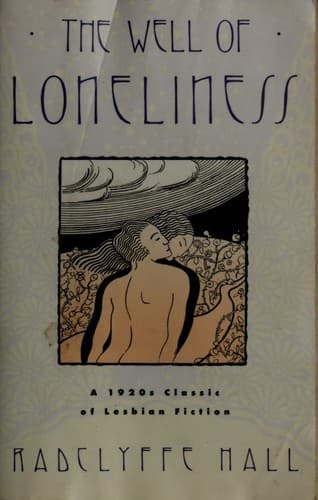
Lesbians -- England -- Social conditions -- Fiction
Stephen said: ‘Are you tired, you little child?’ And her husky voice was
infinitely gentle, so that Mary’s eyes filled with sudden tears.
She answered: ‘I’ve waited a long, long time, all my life—and now that
I’ve found you at last, I can’t get near you. Why is it? Tell me.’
‘Aren’t you near? It seems to me you’re quite near!’ And Stephen must
smile in spite of herself.
‘Yes, but you feel such a long way away.’
‘That’s because you’re not only tired out but foolish!’
Yet they lingered; for when they returned to the villa they would part,
and they dreaded these moments of parting. Sometimes they would suddenly
remember the night before it had fallen, and when this happened each
would be conscious of a very great sadness which their hearts would
divine, the one from the other.
But presently Stephen took Mary’s arm: ‘I believe that big star’s moved
over more than six inches! It’s late—we must have been out here for
ages.’ And she led the girl slowly back to the villa.
4
The days slipped by, days of splendid sunshine that gave bodily health
and strength to Mary. Her pale skin was tanned to a healthful brown, and
her eyes no longer looked heavy with fatigue—only now their expression
was seldom happy.
She and Stephen would ride far afield on their mules; they would often
ride right up into the mountains, climbing the hill to old Orotava where
the women sat at their green postigos through the long, quiet hours of
their indolent day and right on into the evening. The walls of the town
would be covered with flowers, jasmine, plumbago and bougainvillea. But
they would not linger in old Orotava; pressing on they would climb
always up and up to the region of health and trailing arbutus, and
beyond that again to the higher slopes that had once been the home of a
mighty forest. Now, only a few Spanish chestnut trees remained to mark
the decline of that forest.
Sometimes they took their luncheon along, and when they did this young
Pedro went with them, for he it was who must drive the mule that carried
Concha’s ample lunch-basket. Pedro adored these impromptu excursions,
they made an excuse for neglecting the garden. He would saunter along
chewing blades of grass, or the stem of some flower he had torn from a
wall; or perhaps he would sing softly under his breath, for he knew many
songs of his native island. But if the mule Celestino should stumble, or
presume, in his turn, to tear flowers from a wall, then Pedro would
suddenly cease his soft singing and shout guttural remarks to old
Celestino: ‘Vaya, burro! Celestino, arre! Arre—boo!’ he would shout
with a slap, so that Celestino must swallow his flowers in one angry
gulp, before having a sly kick at Pedro.
Public-domain text, read in full here on John Shaqi.
Reviews
Reviews
No reviews yet
Be the first to share your thoughts on this work.
Elsewhere in the archive
Join the Discussion
Join the discussion
Sign in to leave a comment or review.
Sign InorCreate an account