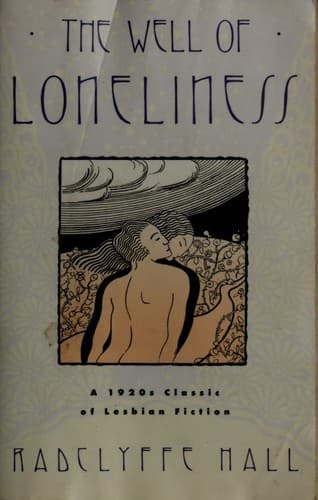
Lesbians -- England -- Social conditions -- Fiction
She walked on not caring very much where she went. It grew dusk, and the
dusk brought with it great longing—the longing to see, to hear, to
touch—almost a physical pain it was, this longing to feel the nearness
of Stephen. But Stephen had left her to go to Morton . . . Morton, that
was surely Stephen’s real home, and in that real home there was no place
for Mary.
She was not resentful. She did not condemn either the world, or herself,
or Stephen. Hers was no mind to wrestle with problems, to demand either
justice or explanation; she only knew that her heart felt bruised so
that all manner of little things hurt her. It hurt her to think of
Stephen surrounded by objects that she had never seen—tables, chairs,
pictures, all old friends of Stephen’s, all dear and familiar, yet
strangers to Mary. It hurt her to think of the unknown bedroom in which
Stephen had slept since the days of her childhood; of the unknown
schoolroom where Stephen had worked; of the stables, the lakes and the
gardens of Morton. It hurt her to think of the two unknown women who
must now be awaiting Stephen’s arrival—Puddle, whom Stephen loved and
respected; Lady Anna, of whom she spoke very seldom, and who, Mary felt,
could never have loved her. And it came upon Mary with a little shock
that a long span of Stephen’s life was hidden; years and years of that
life had come and gone before they two had finally found each other. How
could she hope to link up with a past that belonged to a home which she
might not enter? Then, being a woman, she suddenly ached for the quiet,
pleasant things that a home will stand for—security, peace, respect and
honour, the kindness of parents, the good-will of neighbours; happiness
that can be shared with friends, love that is proud to proclaim its
existence. All that Stephen most craved for the creature she loved, that
creature must now quite suddenly ache for.
And as though some mysterious cord stretched between them, Stephen’s
heart was troubled at that very moment; intolerably troubled because of
Morton, the real home which might not be shared with Mary. Ashamed
because of shame laid on another, compassionate and suffering because of
her compassion, she was thinking of the girl left alone in Paris—the
girl who should have come with her to England, who should have been
welcomed and honoured at Morton. Then she suddenly remembered some words
from the past, very terrible words: ‘Could you marry me, Stephen?’
Public-domain text, read in full here on John Shaqi.
Reviews
Reviews
No reviews yet
Be the first to share your thoughts on this work.
Elsewhere in the archive
Join the Discussion
Join the discussion
Sign in to leave a comment or review.
Sign InorCreate an account