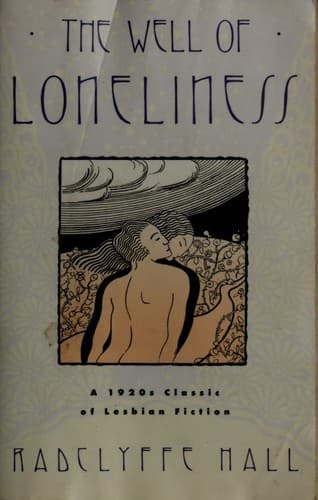
Lesbians -- England -- Social conditions -- Fiction
‘Don’t get ratty and I’ll tell you. Look here, I’m not going to pretend
any more. Of course we all know that you two are lovers. You’re
gradually becoming a kind of legend—all’s well lost for love, and that
sort of thing. . . . But Mary’s too young to become a legend; and so are
you, my dear, for that matter. But you’ve got your work, whereas Mary’s
got nothing—not a soul does that miserable kid know in Paris. Don’t
_please_ interrupt, I’ve not nearly finished; I positively must and will
have my say out! You and she have decided to make a ménage—as far as I
can see it’s as bad as marriage! But if you were a man it would be
rather different; you’d have dozens of friends as a matter of course.
Mary might even be going to have an infant. Oh, for God’s sake, Stephen,
do stop looking shocked. Mary’s a perfectly normal young woman; she
can’t live by love alone, that’s all rot—especially as I shrewdly
suspect that when you’re working the diet’s pretty meagre. For heaven’s
sake let her go about a bit! Why on earth don’t you take her to Valérie
Seymour’s? At Valérie’s place she’d meet lots of people; and I ask you,
what harm could it possibly do? You shun your own ilk as though they
were the devil! Mary needs friends awfully badly, and she needs a
certain amount of amusement. But be a bit careful of the so-called
normal.’ And now Brockett’s voice grew aggressive and bitter. ‘I
wouldn’t go trying to force them to be friends—I’m not thinking so much
of you now as of Mary; she’s young and the young are easily
bruised. . . .’
He was perfectly sincere. He was trying to be helpful, spurred on by his
curious affection for Stephen. At the moment he felt very friendly and
anxious; there was nothing of the cynic left in him—at the moment. He
was honestly advising according to his lights—perhaps the only lights
that the world had left him.
And Stephen could find very little to say. She was sick of denials and
subterfuges, sick of tacit lies which outraged her own instincts and
which seemed like insults thrust upon Mary; so she left Brockett’s
bolder statements unchallenged. As for the rest, she hedged a little,
still vaguely mistrustful of Valérie Seymour. Yet she knew quite well
that Brockett had been right—life these days must often be lonely for
Mary. Why had she never thought of this before? She cursed herself for
her lack of perception.
Then Brockett tactfully changed the subject; he was far too wise not to
know when to stop. So now he told her about his new play, which for him
was a very unusual proceeding. And as he talked on there came over
Stephen a queer sense of relief at the thought that he knew. . . . Yes,
she actually felt a sense of relief because this man knew of her
relations with Mary; because there was no longer any need to behave as
if those relations were shameful—at all events in the presence of
Brockett. The world had at last found a chink in her armour.
6
Public-domain text, read in full here on John Shaqi.
Reviews
Reviews
No reviews yet
Be the first to share your thoughts on this work.
Elsewhere in the archive
Join the Discussion
Join the discussion
Sign in to leave a comment or review.
Sign InorCreate an account