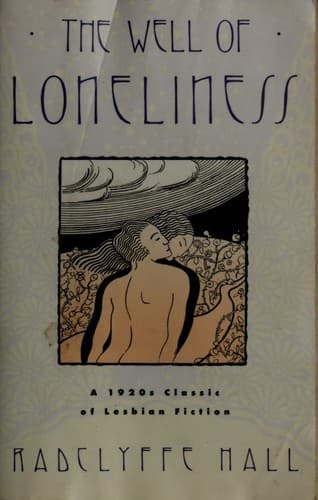
Lesbians -- England -- Social conditions -- Fiction
There was Margaret Roland, the poetess, a woman whose work was alive
with talent. The staunchest of allies, the most fickle of lovers, she
seemed likely enough to end up in the work-house, with her generous
financial apologies which at moments made pretty large holes in her
savings. It was almost impossible not to like her, since her only fault
lay in being too earnest; every fresh love affair was the last while it
lasted, though of course this was apt to be rather misleading. A costly
business in money and tears; she genuinely suffered in heart as in
pocket. There was nothing arresting in Margaret’s appearance, sometimes
she dressed well, sometimes she dressed badly, according to the
influence of the moment. But she always wore ultra feminine shoes, and
frequently bought model gowns when in Paris. One might have said quite a
womanly woman, unless the trained ear had been rendered suspicious by
her voice which had something peculiar about it. It was like a boy’s
voice on the verge of breaking.
And then there was Brockett with his soft, white hands; and several
others there were, very like him. There was also Adolphe Blanc, the
designer—a master of colour whose primitive tints had practically
revolutionized taste, bringing back to the eye the joy of the simple.
Blanc stood in a little niche by himself, which at times must surely
have been very lonely. A quiet, tawny man with the eyes of the Hebrew,
in his youth he had been very deeply afflicted. He had spent his days
going from doctor to doctor: ‘What am I?’ They had told him, pocketing
their fees; not a few had unctuously set out to cure him. Cure him, good
God! There was no cure for Blanc, he was, of all men, the most normal
abnormal. He had known revolt, renouncing his God; he had known despair,
the despair of the godless; he had known wild moments of dissipation; he
had known long months of acute self-abasement. And then he had suddenly
found his soul, and that finding had brought with it resignation, so
that now he could stand in a niche by himself, a pitiful spectator of
what, to him, often seemed a bewildering scheme of creation. For a
living he designed many beautiful things—furniture, costumes and
scenery for ballets, even women’s gowns if the mood was upon him, but
this he did for a physical living. To keep life in his desolate,
long-suffering soul, he had stored his mind with much profound learning.
So now many poor devils went to him for advice, which he never refused
though he gave it sadly. It was always the same: ‘Do the best you can,
no man can do more—but never stop fighting. For us there is no sin so
great as despair, and perhaps no virtue so vital as courage.’ Yes,
indeed, to this gentle and learned Jew went many a poor baptized
Christian devil.
Public-domain text, read in full here on John Shaqi.
Reviews
Reviews
No reviews yet
Be the first to share your thoughts on this work.
Elsewhere in the archive
Join the Discussion
Join the discussion
Sign in to leave a comment or review.
Sign InorCreate an account