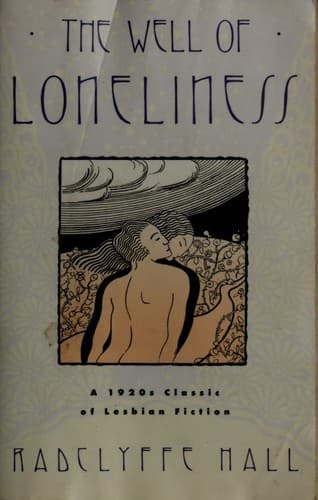
Lesbians -- England -- Social conditions -- Fiction
Miserable, angry, and sorely bewildered, Jamie had put her arm round the
girl. ‘Where can I take you, you poor little creature? You’re not
strong, and I’m terribly poor, remember.’
But Barbara had continued to plead. ‘I’ll work, I’ll scrub floors, I’ll
do anything, Jamie, only let’s get away where nobody knows us!’
So Jamie had turned to her music master in Inverness, and had begged him
to help her. What could she do to earn her living? And because this man
believed in her talent, he had helped her with advice and a small loan
of money, urging her to go to Paris and study to complete her training
in composition.
‘You’re really too good for me,’ he had told her; ‘and out there you
could live considerably cheaper. For one thing the exchange would be in
your favour. I’ll write to the head of the Conservatoire this evening.’
That had been shortly after the Armistice, and now here they were
together in Paris.
As for Pat, she collected her moths and her beetles, and when fate was
propitious an occasional woman. But fate was so seldom propitious to
Pat—Arabella had put this down to the beetles. Poor Pat, having
recently grown rather gloomy, had taken to quoting American history,
speaking darkly of blood-tracks left on the snow by what she had
christened: ‘The miserable army.’ Then too she seemed haunted by General
Custer, that gallant and very unfortunate hero. ‘It’s Custer’s last
ride, all the time,’ she would say. ‘No good talking, the whole darned
world’s out to scalp us!’
As for Margaret Roland, she was never attracted to anyone young and
whole-hearted and free—she was, in fact, a congenital poacher.
While as for Wanda, her loves were so varied that no rule could be
discovered by which to judge them. She loved wildly, without either
chart or compass. A rudderless bark it was, Wanda’s emotion, beaten now
this way now that by the gale, veering first to the normal, then to the
abnormal; a thing of torn sails and stricken masts, that never came
within sight of a harbour.
3
These, then, were the people to whom Stephen turned at last in her fear
of isolation for Mary; to her own kind she turned and was made very
welcome, for no bond is more binding than that of affliction. But her
vision stretched beyond to the day when happier folk would also accept
her, and through her this girl for whose happiness she and she alone
would have to answer; to the day when through sheer force of tireless
endeavour she would have built that harbour of refuge for Mary.
So now they were launched upon the stream that flows silent and deep
through all great cities, gliding on between precipitous borders, away
and away into no-man’s-land—the most desolate country in all creation.
Yet when they got home they felt no misgivings, even Stephen’s doubts
had been drugged for the moment, since just at first this curious stream
will possess the balm of the waters of Lethe.
Public-domain text, read in full here on John Shaqi.
Reviews
Reviews
No reviews yet
Be the first to share your thoughts on this work.
Elsewhere in the archive
Join the Discussion
Join the discussion
Sign in to leave a comment or review.
Sign InorCreate an account