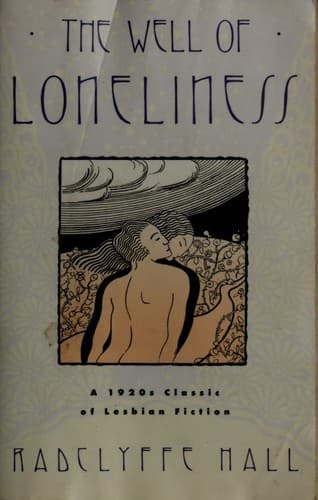
Lesbians -- England -- Social conditions -- Fiction
The gossip had reached the minister, Jamie’s white-haired and gentle old
father. He had looked at the girl with bewildered eyes—he had always
been bewildered by his daughter. A poor housewife she was, and very
untidy; if she cooked she mucked up the pots and the kitchen, and her
hands were strangely unskilled with the needle; this he knew, since his
heels suffered much from her darning. Remembering her mother he had
shaken his head and sighed many times as he looked at Jamie. For her
mother had been a soft, timorous woman, and he himself was very
retiring, but their Jamie loved striding over the hills in the teeth of
a gale, an uncouth, boyish creature. As a child she had gone rabbit
stalking with ferrets; had ridden a neighbour’s farmhorse astride on a
sack, without stirrup, saddle or bridle; had done all manner of
outlandish things. And he, poor lonely, bewildered man, still mourning
his wife, had been no match for her.
Yet even as a child she had sat at the piano and picked out little tunes
of her own inventing. He had done his best; she had been taught to play
by Miss Morrison of the next-door village, since music alone seemed able
to tame her. And as Jamie had grown so her tunes had grown with her,
gathering purpose and strength with her body. She would improvise for
hours on the winter evenings, if Barbara would sit in their parlour and
listen. He had always made Barbara welcome at the manse; they had been
so inseparable, those two, since childhood—and now? He had frowned,
remembering the gossip.
Rather timidly he had spoken to Jamie. ‘Listen, my dear, when you’re
always together, the lads don’t get a chance to come courting, and
Barbara’s grandmother wants the lass married. Let her walk with a lad on
Sabbath afternoons—there’s that young MacGregor, he’s a fine, steady
fellow, and they say he’s in love with the little lass. . . .’
Jamie had stared at him, scowling darkly. ‘She doesn’t want to walk out
with MacGregor!’
The minister had shaken his head yet again. In the hands of his child he
was utterly helpless.
Then Jamie had gone to Inverness in order the better to study music, but
every week-end she had spent at the manse, there had been no real break
in her friendship with Barbara; indeed they had seemed more devoted than
ever, no doubt because of these forced separations. Two years later the
minister had suddenly died, leaving his little all to Jamie. She had had
to turn out of the old, grey manse, and had taken a room in the village
near Barbara. But antagonism, no longer restrained through respect for
the gentle and child-like pastor, had made itself very acutely
felt—hostile they had been, those good people, to Jamie.
Barbara had wept. ‘Jamie, let’s go away . . . they hate us. Let’s go
where nobody knows us. I’m twenty-one now, I can go where I like, they
can’t stop me. Take me away from them, Jamie!’
Public-domain text, read in full here on John Shaqi.
Reviews
Reviews
No reviews yet
Be the first to share your thoughts on this work.
Elsewhere in the archive
Join the Discussion
Join the discussion
Sign in to leave a comment or review.
Sign InorCreate an account