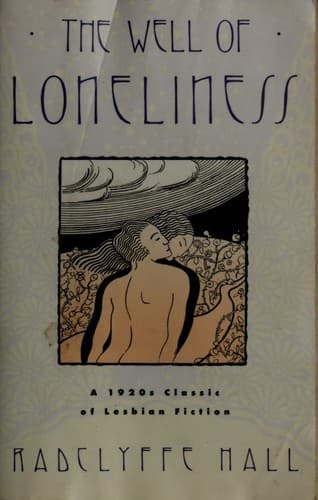
Lesbians -- England -- Social conditions -- Fiction
They were very unlike each other, these negroes; Lincoln, the elder, was
paler in colour. He was short and inclined to be rather thick-set with a
heavy but intellectual face—a strong face, much lined for a man of
thirty. His eyes had the patient, questioning expression common to the
eyes of most animals and to those of all slowly evolving races. He shook
hands very quietly with Stephen and Mary. Henry was tall and as black as
a coal; a fine, upstanding, but coarse-lipped young negro, with a roving
glance and a self-assured manner.
He remarked: ‘Glad to meet you, Miss Gordon—Miss Llewellyn,’ and
plumped himself down at Mary’s side, where he started to make
conversation, too glibly.
Valérie Seymour was soon talking to Lincoln with a friendliness that put
him at his ease—just at first he had seemed a little self-conscious.
But Pat was much more reserved in her manner, having hailed from
abolitionist Boston.
Wanda said abruptly: ‘Can I have a drink, Jamie?’ Brockett poured her
out a stiff brandy and soda.
Adolphe Blanc sat on the floor hugging his knees; and presently Dupont
the sculptor strolled in—being minus his mistress he migrated to
Stephen.
Then Lincoln seated himself at the piano, touching the keys with firm,
expert fingers, while Henry stood beside him very straight and long and
lifted up his voice which was velvet smooth, yet as clear and insistent
as the call of a clarion:
‘Deep, river, my home is over Jordan.
Deep river—Lord, I want to cross over into camp ground,
Lord, I want to cross over into camp ground,
Lord, I want to cross over into camp ground. . . .’
And all the hope of the utterly hopeless of this world, who must live by
their ultimate salvation, all the terrible, aching, homesick hope that
is born of the infinite pain of the spirit, seemed to break from this
man and shake those who listened, so that they sat with bent heads and
clasped hands—they who were also among the hopeless sat with bent heads
and clasped hands as they listened. . . . Even Valérie Seymour forgot to
be pagan.
He was not an exemplary young negro; indeed he could be the reverse very
often. A crude animal Henry could be at times, with a taste for liquor
and a lust for women—just a primitive force rendered dangerous by
drink, rendered offensive by civilization. Yet as he sang his sins
seemed to drop from him, leaving him pure, unashamed, triumphant. He
sang to his God, to the God of his soul, Who would some day blot out all
the sins of the world, and make vast reparation for every injustice: ‘My
home is over Jordan, Lord, I want to cross over into camp ground.’
Lincoln’s deep bass voice kept up a low sobbing. From time to time only
did he break into words; but as he played on he rocked his body: ‘Lord,
I want to cross over into camp ground. Lord, I want to cross over into
camp ground.’
Public-domain text, read in full here on John Shaqi.
Reviews
Reviews
No reviews yet
Be the first to share your thoughts on this work.
Elsewhere in the archive
Join the Discussion
Join the discussion
Sign in to leave a comment or review.
Sign InorCreate an account