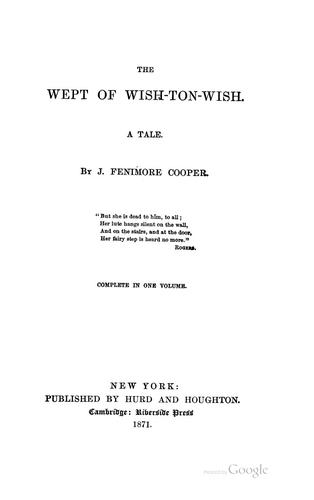
Historical fiction; King Philip's War, 1675-1676 -- Fiction; War stories
But the path of the faithful, though full of thorns,
leadeth to quiet, and the final rest of the just man can never know alarm.
He that hath borne hunger, and thirst, and the pains of the flesh, for the
sake of truth, knoweth how to be satisfied; nor will the hours of bodily
suffering be accounted weary to him whose goal is the peace of the
righteous." The strong lineaments of the stranger grew even more than
usually austere, and as the Puritan continued, the hand which rested on
the handle of a pistol grasped the weapon, until the fingers seemed
imbedded in the wood. He bowed, however, as if to acknowledge the personal
allusion, and remained silent.
"If any mourn the early death of those who have rendered up their being,
struggling, as it may be permitted, in behalf of life and dwelling,"
continued Mark Heathcote, regarding a female near him, "let her remember,
that from the beginning of the world were his days numbered, and that not
a sparrow falleth without answering the ends of wisdom. Rather let the
fulfilment of things remind us of the vanity of life, that we may learn
how easy it is to become immortal. If the youth hath been cut down,
seemingly like unripened grass, he hath fallen by the sickle of one who
knoweth best when to begin the in-gathering of the harvest to his eternal
garners. Though a spirit bound unto his, as one feeble is wont to lean on
the strength of man and mourn over his fall, let her sorrow be mingled
with rejoicing." A convulsive sob broke out of the bosom of the handmaiden
who was known to have been affianced to one of the dead, and for a moment
the address of Mark was interrupted. But when silence again ensued, he
continued, the subject leading him, by a transition that was natural, to
allude to his own sorrows. "Death hath been no stranger in my habitation,"
he said. "His shaft fell heaviest, when it struck her, who, like those
that have here fallen, was in the pride of her youth, and when her soul
was glad with the first joy of the birth of a man-child! Thou who sittest
on high!" he added, turning a glazed and tear less eye to heaven; "thou
knowest how heavy was that blow, and thou hast written down the strivings
of an oppressed soul. The burthen was not found too heavy for endurance.
The sacrifice hath not sufficed; the world was again getting uppermost in
my heart. Thou didst bestow an image of that innocence and loveliness that
dwelleth in the skies, and this hast thou taken away, that we might know
thy power. To this judgment we bow. If thou hast called our child to the
mansions of bliss, she is wholly thine, and we presume not to complain;
but if thou hast still left her to wander further in the pilgrimage of
life, we confide in thy goodness. She is of a long-suffering race, and
thou wilt not desert her to the blindness of the heathen. She is thine,
she is wholly thine, King of Heaven! and yet hast thou permitted our
hearts to yearn towards her, with the fondness of earthly love. We await
Public-domain text, read in full here on John Shaqi.
Reviews
Reviews
No reviews yet
Be the first to share your thoughts on this work.
Elsewhere in the archive
Join the Discussion
Join the discussion
Sign in to leave a comment or review.
Sign InorCreate an account