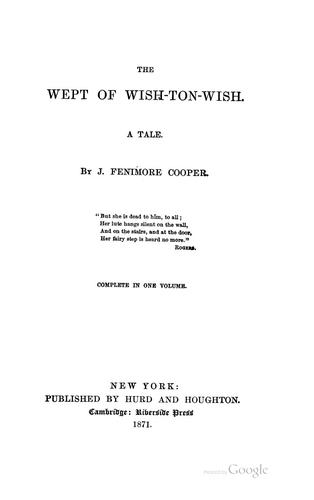
Historical fiction; King Philip's War, 1675-1676 -- Fiction; War stories
Thus it is that high civilization, a state of infant existence, and
positive barbarity, are often brought so near each other, within the
borders of this republic. The traveller, who has passed the night in an
inn that would not disgrace the oldest country in Europe, may be compelled
to dine in the shantee [Footnote: _Shanty_, or _Shantee_, is a word much
used in the newer settlements. It strictly means a rude cabin of bark and
brush, such as is often erected in the forest for temporary purposes. But
the borderers often quaintly apply it to their own habitations. The only
derivation which the writer has heard for this American word, is one that
supposes it to be a corruption of _Chiente_, a term said to be used among
the Canadians to express a dog-kennel.] of a hunter; the smooth and
gravelled road sometimes ends in an impassable swamp; the spires of the
town are often hid by the branches of a tangled forest, and the canal
leads to a seemingly barren and unprofitable mountain. He that does not
return to see what another year may bring forth, commonly bears away from
these scenes, recollections that conduce to error. To see America with the
eyes of truth, it is necessary to look often; and in order to understand
the actual condition of these states, it should be remembered, that it is
equally unjust to believe that all the intermediate points partake of the
improvements of particular places, as to infer the want of civilization at
more remote establishments, from a few unfavorable facts gleaned near the
centre. By an accidental concurrence of moral and physical causes, much of
that equality which distinguishes the institutions of the country is
extended to the progress of society over its whole surface.
Although the impetus of improvement was not as great in the time of Mark
Heathcote as in our own days, the principle of its power was actively in
existence. Of this fact we shall furnish a sufficient evidence, by
pursuing our intention of describing one of those changes to which
allusion has already been made.
The reader will remember that the age of which we write had advanced into
the last quarter of the seventeenth century. The precise moment at which
the action of the tale must re-commence, was that period of the day when
the gray of twilight was redeeming objects from the deep darkness with
which the night draws to its close. The month was June, and the scene such
as it may be necessary to describe with some particularity.
Public-domain text, read in full here on John Shaqi.
Reviews
Reviews
No reviews yet
Be the first to share your thoughts on this work.
Elsewhere in the archive
Join the Discussion
Join the discussion
Sign in to leave a comment or review.
Sign InorCreate an account