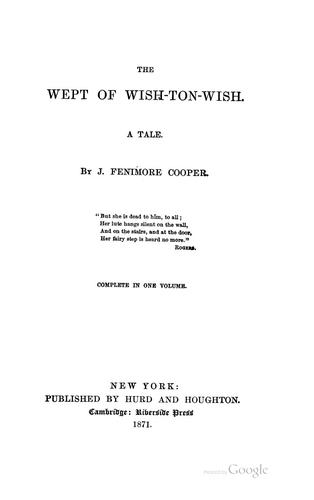
Historical fiction; King Philip's War, 1675-1676 -- Fiction; War stories
Had there been light, and had one been favorably placed to enjoy a
bird's-eye view of the spot, he would have seen a broad and undulating
field of leafy forest, in which the various deciduous trees of New-England
were relieved by the deeper verdure of occasional masses of evergreens. In
the centre of this swelling and nearly interminable outline of woods, was
a valley that spread between three low mountains. Over the bottom-land,
for the distance of several miles, all the signs of a settlement in a
state of rapid and prosperous improvement were visible. The devious course
of a deep and swift brook, that in the other hemisphere would have been
termed a river, was to be traced through the meadows by its borders of
willow and sumach. At a point near the centre of the valley, the waters
had been arrested by a small dam; and a mill, whose wheel at that early
hour was without motion, stood on the artificial mound. Near it was the
site of a New-England hamlet.
The number of dwellings in the village might have been forty. They were,
as usual, constructed of a firm frame-work, neatly covered with sidings of
boards. There was a surprising air of equality in the general aspect of
the houses; and, if there were question of any country but our own, it
might be added there was an unusual appearance of comfort and abundance in
even the humblest of them all. They were mostly of two low stories, the
superior overhanging the inferior, by a foot or two; a mode of
construction much in use in the earlier days of the Eastern Colonies. As
paint was but little used at that time, none of the buildings exhibited a
color different from that the wood would naturally assume, after the
exposure of a few years to the weather. Each had its single chimney in the
centre of the roof, and but two or three showed more than a solitary
window on each side of the principal or outer door. In front of every
dwelling was a small neat court, in green sward, separated from the public
road by a light fence of deal. Double rows of young and vigorous elms
lined each side of the wide street, while an enormous sycamore still kept
possession of the spot, in its centre, which it had occupied when the
white man entered the forest. Beneath the shade of this tree the
inhabitants often collected, to gather tidings of each others welfare, or
to listen to some matter of interest that rumor had borne from the towns
nearer the sea. A narrow and little-used wheel-track ran, with a graceful
and sinuous route, through the centre of the wide and grassy street.
Reduced in appearance to little more than a bridle-path, it was to be
traced, without the hamlet, between high fences of wood, for a mile or
two, to the points where it entered the forest. Here and there, roses were
pressing through the openings of the fences before the doors of the
different habitations, and bushes of fragrant lilacs stood in the angles
of most of the courts.
Public-domain text, read in full here on John Shaqi.
Reviews
Reviews
No reviews yet
Be the first to share your thoughts on this work.
Elsewhere in the archive
Join the Discussion
Join the discussion
Sign in to leave a comment or review.
Sign InorCreate an account