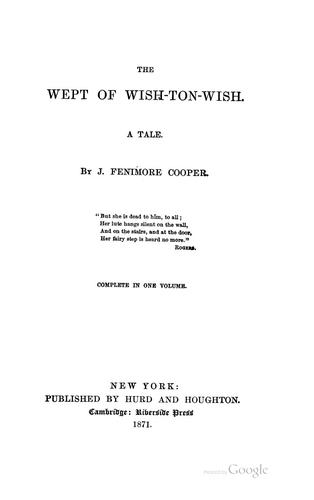
Historical fiction; King Philip's War, 1675-1676 -- Fiction; War stories
The dwellings were detached. Each occupied its own insulated plot of
ground, with a garden in its rear. The out-buildings were thrown to that
distance which the cheapness of land, and security from fire, rendered
both easy and expedient.
The church stood in the centre of the highway, and near one end of the
hamlet. In the exterior and ornaments of the important temple, the taste
of the times had been fastidiously consulted, its form and simplicity
furnishing no slight resemblance to the self-denying doctrines and quaint
humors of the religionists who worshipped beneath its roof. The building,
like all the rest, was of wood, and externally of two stories. It
possessed a tower, without a spire; the former alone serving to betray its
sacred character. In the construction of this edifice, especial care had
been taken to eschew all deviations from direct lines and right angles.
Those narrow-arched passages for the admission of light, that are
elsewhere so common, were then thought, by the stern moralists of
New-England, to have some mysterious connexion with her of the scarlet
mantle. The priest would as soon have thought of appearing before his
flock in the vanities of stole and cassock, as the congregation of
admitting the repudiated ornaments into the outline of their severe
architecture. Had the Genii of the Lamp suddenly exchanged the windows of
the sacred edifice with those of the inn that stood nearly opposite, the
closest critic of the settlement could never have detected the liberty,
since, in the form, dimensions, and style of the two, there was no visible
difference.
A little inclosure, at no great distance from the church, and on one side
of the street, had been set apart for the final resting-place of those who
had finished their race on earth. It contained but a solitary grave.
The inn was to be distinguished from the surrounding buildings, by its
superior size, an open horse-shed, and a sort of protruding air, with
which it thrust itself on the line of the street, as if to invite the
traveller to enter. A sign swung on a gallows-looking post, that, in
consequence of frosty nights and warm days, had already deviated from the
perpendicular. It bore a conceit that, at the first glance, might have
gladdened the heart of a naturalist, with the belief that he had made the
discovery of some unknown bird. The artist, however, had sufficiently
provided against the consequences of so embarrassing a blunder, by
considerately writing beneath the offspring of his pencil, "This is the
sign of the Whip-Poor-Will;" a name, that the most unlettered traveller,
in those regions, would be likely to know was vulgarly given to the
Wish-Ton-Wish, or the American night-hawk.
Public-domain text, read in full here on John Shaqi.
Reviews
Reviews
No reviews yet
Be the first to share your thoughts on this work.
Elsewhere in the archive
Join the Discussion
Join the discussion
Sign in to leave a comment or review.
Sign InorCreate an account