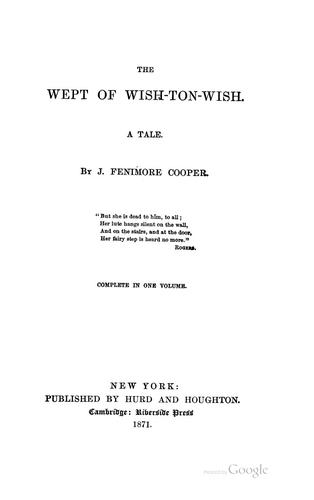
Historical fiction; King Philip's War, 1675-1676 -- Fiction; War stories
At an early hour in the forenoon, a little bell, that was suspended in an
awkward belfry perched on the roof of the meeting-house, began to summon
the congregation to the place of worship. The call was promptly obeyed,
and ere the first notes had reached the echoes of the hills, the wide and
grassy street was covered with family groups, all taking the same
direction. Foremost in each little party walked the austere father,
perhaps bearing on his arm a suckled infant, or some child yet too young
to sustain its own weight; while at a decent distance followed the equally
grave matron, casting oblique and severe glances at the little troop
around her, in whom acquired habits had yet some conquests to obtain over
the lighter impulses of vanity. Where there was no child to need support,
or where the mother chose to assume the office of bearing her infant in
person, the man was seen to carry one of the heavy muskets of the day; and
when his arms were otherwise employed, the stoutest of his boys served in
the capacity of armor-bearer. But in no instance was this needful
precaution neglected, the state of the Province and the character of the
enemy requiring that vigilance should mingle even with their devotions.
There was no loitering on the path, no light and worldly discourse by the
way, nor even any salutations, other than those grave and serious
recognitions by hat and eye, which usage tolerated as the utmost limit of
courtesy on the weekly festival.
When the bell changed its tone, Meek appeared from the gate of the
fortified house, where he resided, in quality of castellan, on account of
its public character, its additional security, and the circumstance that
his studious habits, permitted him to discharge the trust with less waste
of manual labor than it would cost the village were the responsible
office confided to one of more active habits. His consort followed, but
at even a greater distance than that taken by the wives of other men, as
if she felt the awful necessity of averting even the remotest possibility
of scandal from one of so sacred a profession. Nine offspring of various
ages, and one female assistant, of years too tender to be a wife herself,
composed the household of the divine, and it was a proof of the
salubrious air of the valley that all were present, since nothing but
illness was ever deemed a sufficient excuse for absence from the common
worship. As this little flock issued from the palisadoes, a female, in
whose pale cheek the effects of recent illness might yet be traced, held
open the gate for the entrance of Reuben King, and a stout youth, who
bore the prolific consort of the former, with her bounteous gift, into
the citadel of the village; a place of refuge that nothing but the
undaunted resolution of the woman prevented her from occupying before,
since more than half of the children of the valley had first seen the
light within the security of its defences.
Public-domain text, read in full here on John Shaqi.
Reviews
Reviews
No reviews yet
Be the first to share your thoughts on this work.
Elsewhere in the archive
Join the Discussion
Join the discussion
Sign in to leave a comment or review.
Sign InorCreate an account