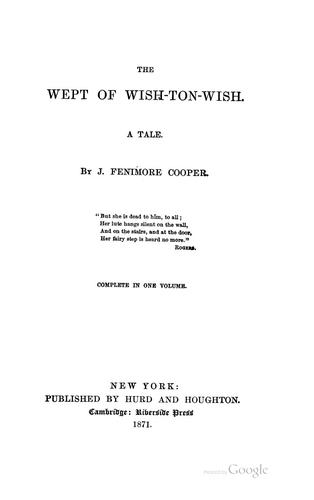
Historical fiction; King Philip's War, 1675-1676 -- Fiction; War stories
On the other hand, when the chief turned in anger, to strike the daring
one who presumed to arrest his arm, he saw at his feet the kneeling
figure, the uplifted hands, and agonized features, of Martha. Averting the
blow that a follower already aimed at the life of the suppliant, he spoke
rapidly in his own language, and pointed to the struggling Mark. The
nearest Indians cast themselves on the already half-captured youth. A
whoop brought a hundred more to the spot, and then a calm as sudden, and
almost as fearful, as the previous tumult, prevailed in the orchard. It
was succeeded by the long-drawn, frightful, and yet meaning yell by which
the American warrior proclaims his victory.
With the end of the tumult in the orchard, the sounds of strife ceased in
all the valley. Though conscious of the success of their enemies, the men
in the fort saw the certainty of destruction, not only to themselves, but
to those feeble ones whom they should be compelled to leave without a
sufficient defence, were they to attempt a sortie to that distance from
their works. They were therefore compelled to remain passive and grave
spectators of an evil they had not the means to avert.
Chapter XXIV.
"Were such things here, as we do speak about?
Or have we eaten of the insane root
That takes the reason prisoner?"
Macbeth.
An hour later presented a different scene. Bands of the enemy, that in
civilized warfare would be called parties of observation, lingered in the
skirts of the forest nearest to the village; and the settlers still stood
to their arms, posted among the buildings, or maintaining their array at
the foot of the palisadoes. Though the toil of securing the valuables
continued, it was evident that, as the first terrors of alarm had
disappeared, the owners of the hamlet began to regain some assurance in
their ability to make it good against their enemies. Even the women were
now seen moving through its grassy street with greater seeming confidence,
and there was a regularity in the air of the armed men, which denoted a
determination that was calculated to impose on their wild and
undisciplined assailants.
Public-domain text, read in full here on John Shaqi.
Reviews
Reviews
No reviews yet
Be the first to share your thoughts on this work.
Elsewhere in the archive
Join the Discussion
Join the discussion
Sign in to leave a comment or review.
Sign InorCreate an account