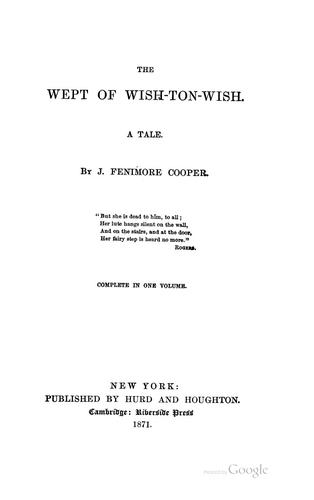
Historical fiction; King Philip's War, 1675-1676 -- Fiction; War stories
"Narra-mattah, come near;" returned the young chief, changing the deep and
proud tones in which he had addressed his restless and bold companion in
arms, to those which better suited the gentle ear for which his words were
intended. "Fear not, daughter of the morning, for those around us are of a
race used to see women at the council-fires. Now look, with an open
eye--is there anything among these trees that seemeth like an ancient
tradition? Hast ever beheld such a valley, in thy dreams? Have yonder
Pale-faces, whom the tomahawks of my young men spared, been led before
thee by the Great Spirit, in the dark night?"
The female listened, in deep attention. Her gaze was wild and uncertain,
and yet it was not absolutely without gleamings of a half-reviving
intelligence. Until that moment, she had been too much occupied in
conjecturing the subject of her visit, to regard the natural objects by
which she was surrounded: but with her attention thus directly turned upon
them, her organs of sight embraced each and all, with the discrimination
that is so remarkable in those whose faculties are quickened by danger and
necessity. Passing from side to side, her swift glances ran over the
distant hamlet, with its little fort; the buildings in the near grounds;
the soft and verdant fields; the fragrant orchard, beneath whose leafy
shades she stood, and the blackened tower, that rose in its centre, like
some gloomy memorial, placed there to remind the spectator not to trust
too fondly to the signs of peace and loveliness that reigned around.
Shaking back the ringlets that had blown about her temples, the wondering
female returned thoughtfully and in silence to her place.
"'Tis a village of the Yengeese!" she said, after a long and expressive
pause. "A Narragansett woman does not love to look at the lodges of the
hated race."
"Listen.--Lies have never entered the ears of Narra-mattah. My tongue hath
spoken like the tongue of a chief. Thou didst not come of the sumach, but
of the snow. This hand of thine is not like the hands of the women of my
tribe; it is little, for the Great Spirit did not make it for work; it is
of the color of the sky in the morning, for thy fathers were born near the
place where the sun rises. Thy blood is like spring-water. All this thou
knowest, for none have spoken false in thy ear. Speak--dost thou never see
the wigwam of thy father? Does not his voice whisper to thee, in the
language of his people?"
The female stood in the attitude which a sibyl might be supposed to
assume, while listening to the occult mandates of the mysterious oracle,
every faculty entranced and attentive.
Public-domain text, read in full here on John Shaqi.
Reviews
Reviews
No reviews yet
Be the first to share your thoughts on this work.
Elsewhere in the archive
Join the Discussion
Join the discussion
Sign in to leave a comment or review.
Sign InorCreate an account