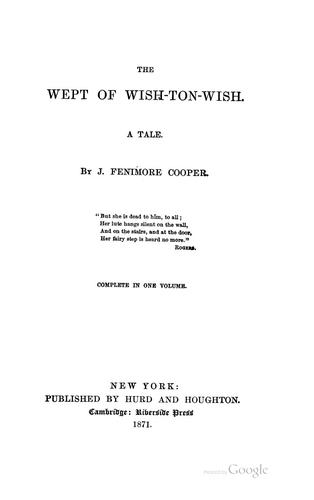
Historical fiction; King Philip's War, 1675-1676 -- Fiction; War stories
The singularly restrained habits of the religionists, throughout the whole
of the British provinces, were in marked opposition to the mere
embellishments of life. The arts were permitted only as they served its
most useful and obvious purposes. With them, music was confined to the
worship of God, and, for a long time after the original settlement, the
song was never known to lead the mind astray from what was conceived to be
the one great object of existence. No verse was sung, but such as blended
holy ideas with the pleasures of harmony; nor were the sounds of revelry
ever heard within their borders. Still, words adapted to their particular
condition had come into use, and though poetry was neither a common nor a
brilliant property of the mind, among a people thus disciplined in ascetic
practices, it early exhibited its power in quaint versification, that was
always intended, though with a success it is almost pardonable to doubt,
to redound to the glory of the Deity. It was but a natural enlargement of
this pious practice, to adapt some of these spiritual songs to the
purposes of the nursery.
When Ruth Heathcote passed her hand thoughtfully across her brow, it was
with a painful conviction that her dominion over the mind of her child
was sadly weakened, if not lost for ever. But the efforts of maternal love
are not easily repulsed. An idea flashed upon her brain, and she proceeded
to try the efficacy of the experiment it suggested. Nature had endowed her
with a melodious voice, and an ear that taught her to regulate sounds in a
manner that seldom failed to touch the heart. She possessed the genius of
music, which is melody, unweakened by those exaggerated affectations with
which it is often encumbered by what is pretendingly called science.
Drawing her daughter nearer to her knee, she commenced one of the songs
then much used by the mothers of the Colony, her voice scarcely rising
above the whispering of the evening air, in its first notes, but gradually
gaining, as she proceeded, the richness and compass that a strain so
simple required.
At the first low breathing notes of this nursery song, Narra-mattah became
as motionless as if her rounded and unfettered form had been wrought in
marble. Pleasure lighted her eyes, as strain succeeded strain; and ere the
second verse was ended, her look, her attitude, and every muscle of her
ingenuous features, were eloquent in the expression of delight. Ruth did
not hazard the experiment without trembling for its result. Emotion
imparted feeling to the music, and when, for the third time in the course
of her song, she addressed her child, the saw the soft blue eyes that
gazed wistfully on her face swimming in tears. Encouraged by this
unequivocal evidence of success, nature grew still more powerful in its
efforts, and the closing verse was sung to an ear that nestled near her
heart, as it had often done during the early years of Narra-mattah while
listening to its melancholy melody.
Public-domain text, read in full here on John Shaqi.
Reviews
Reviews
No reviews yet
Be the first to share your thoughts on this work.
Elsewhere in the archive
Join the Discussion
Join the discussion
Sign in to leave a comment or review.
Sign InorCreate an account