Americans -- Italy -- Fiction; Children of the rich -- Fiction; Love stories
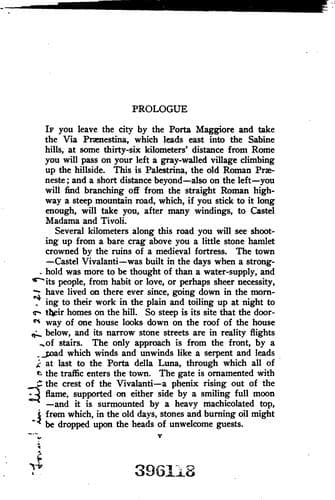
The lower slopes of the hill on which the village stands are well
wooded and green with stone-pines and cypresses, olive orchards and
vineyards. Here the princes built their villas when the wars with the
popes were safely at an end and they could risk coming down from their
stronghold on the mountain. The old villa was built about a mile below
the town, and the gardens were laid out in terraces and parterres along
the slope of the hill. It has long been in ruin, but its foundations
still stand, and the plan of the gardens may easily be traced. You will
see the entrance at the left of the road—a massive stone gateway
topped with moss-covered urns and a double row of cone-shaped cypresses
bordering a once stately avenue now grown over with weeds. If you pause
for a moment—and you cannot help doing so—you will see, between the
portals at the end of the avenue, some crumbling arches, and even, if
your eyes are good, the fountain itself.
Any contadino that you meet on the road will tell you the story of the
old Villa Vivalanti and the ‘Bad Prince’ who was (by the grace of God)
murdered two centuries ago. He will tell you—a story not uncommon in
Italy—of storehouses bursting with grain while the peasants were
starving, and of how, one moonlight night, as the prince was strolling
on the terrace contentedly pondering his wickednesses of the day, a
peasant from his own village up on the mountain, creeping behind him,
quiet as a cat, stabbed him in the back and dropped his body in the
fountain. He will tell you how the light from the burning villa was
seen as far as Rocca di Papa in the Alban hills; and he will add, with
a laugh and a shrug, that some people say when the moon is full the old
prince comes back and sits on the edge of the fountain and thinks of
his sins, but that, for himself, he thinks it an old woman’s tale.
Whereupon he will cast a quick glance over his shoulder at the dark
shadow of the cypresses and covertly cross himself as he wishes you,
‘_A revederla_.’
You cannot wonder that the young prince (two centuries ago) did not
build his new villa on the site of the old; for even had he, like the
brave contadino, cared nothing for ghosts, still it was scarcely a
hallowed spot, and lovers would not care to stroll by the fountain. So
it happens that you must travel some distance further along the same
road before you reach the gates of the new villa, built anno domini
1693, in the pontificate of his Holiness Innocent XII. Here you will
find no gloomy cypresses: the approach is bordered by spreading
plane-trees. The villa itself is a rambling affair, and, though
slightly time-worn, is still decidedly imposing, with its various
wings, its balconies and loggia and marble terrace.
Public-domain text, read in full here on John Shaqi.
Reviews
Reviews
No reviews yet
Be the first to share your thoughts on this work.
Join the Discussion
Join the discussion
Sign in to leave a comment or review.
Sign InorCreate an account