England -- Social life and customs -- 19th century -- Fiction; English fiction -- 19th century
Produced by Charles Aldarondo. HTML version by Al Haines.
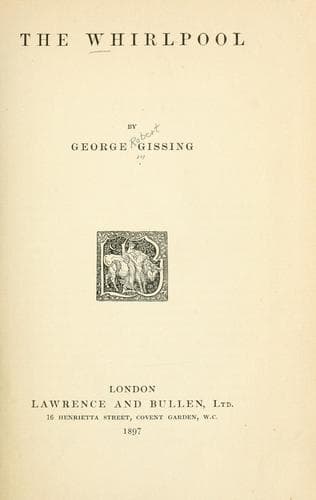
The Whirlpool
by
George Gissing
Part the First
CHAPTER 1
Harvey Rolfe was old enough to dine with deliberation, young and
healthy enough to sauce with appetite the dishes he thoughtfully
selected. You perceived in him the imperfect epicure. His club had no
culinary fame; the dinner was merely tolerable; but Rolfe's unfinished
palate flattered the second-rate cook. He knew nothing of vintages; it
sufficed him to distinguish between Bordeaux and Burgundy; yet one saw
him raise his glass and peer at the liquor with eye of connoisseur. All
unaffectedly; for he was conscious of his shortcoming in the art of
delicate living, and never vaunted his satisfactions. He had known the
pasture of poverty, and the table as it is set by London landladies; to
look back on these things was to congratulate himself that nowadays he
dined.
Beyond the achievement of a vague personal distinction at the
Metropolitan Club, he had done nothing to make himself a man of note,
and it was doubtful whether more than two or three of the members
really liked him or regarded him with genuine interest. His
introduction to this circle he owed to an old friend, Hugh Carnaby,
whose social position was much more clearly defined: Hugh Carnaby, the
rambler, the sportsman, and now for a twelvemonth the son-in-law of
Mrs. Ascott Larkfield. Through Carnaby people learnt as much of his
friend's history as it concerned anyone to know: that Harvey Rolfe had
begun with the study of medicine, had given it up in disgust,
subsequently was 'in business', and withdrew from it on inheriting a
competency. They were natives of the same county, and learnt their
Latin together at the Grammar School of Greystone, the midland town
which was missed by the steam highroad, and so preserves much of the
beauty and tranquillity of days gone by. Rolfe seldom spoke of his own
affairs, but in talking of travel he had been heard to mention that his
father had engineered certain lines of foreign railway. It seemed that
Harvey had no purpose in life, save that of enjoying himself. Obviously
he read a good deal, and Carnaby credited him with profound historical
knowledge; but he neither wrote nor threatened to do so. Something of
cynicism appeared in his talk of public matters; politics amused him,
and his social views lacked consistency, tending, however, to an
indolent conservatism. Despite his convivial qualities, he had traits
of the reserved, even of the unsociable, man: a slight awkwardness in
bearing, a mute shyness with strangers, a hesitancy in ordinary talk,
and occasional bluntness of assertion or contradiction, suggesting a
contempt which possibly he did not intend. Hugh Carnaby declared that
the true Rolfe only showed himself after a bottle of wine; maintained,
moreover, that Harvey had vastly improved since he entered upon a
substantial income. When Rolfe was five and twenty, Hugh being two
Public-domain text, read in full here on John Shaqi.
Reviews
Reviews
No reviews yet
Be the first to share your thoughts on this work.
Join the Discussion
Join the discussion
Sign in to leave a comment or review.
Sign InorCreate an account