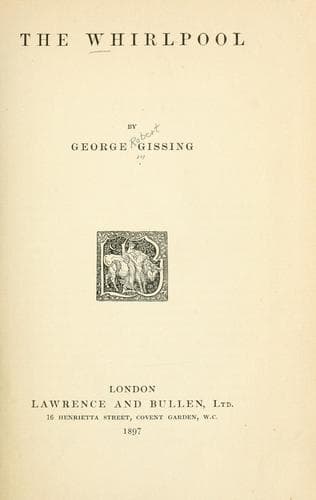
England -- Social life and customs -- 19th century -- Fiction; English fiction -- 19th century
Dora and Gerda, having grown up in such domestic circumstances,
accepted them with equanimity. When their father spoke nervously of
retrenchment, saying that he grew old and must save money to provide
for their future, they made no objection, but were as far as ever from
perceiving the sordid tragedy of his lot. Dora lived for her music;
Gerda sang a little, but was stronger on the social side, delighting in
festivities and open-air amusements. They were amiable and intelligent
girls, and would have been amazed had anyone charged them with
selfishness; no less if it had been suggested to them that they
personally might rectify the domestic disorder of which at times they
were moved to complain. They had no beauty, and knew it; neither had
received an offer of marriage, and they looked for nothing of the kind.
That their dresses cost a great deal, was taken as a matter of course;
also that they should go abroad when other people did, and have the
best places at concert or theatre, and be expansively 'at home'. With
all sincerity they said of themselves that they lived a quiet life. How
could it be quieter?--unless one followed the example of Alma Rolfe;
but Alma was quite an exceptional person--to be admired and liked, not
to be imitated.
Yet even Alma, it seemed, had got tired of her extraordinary freak. She
was back again within the circle of civilisation; or, as she put it in
her original, amusing way, 'on the outer edge of the whirlpool'. She
had a very nice little house, beautifully furnished; everyone knew
Alma's excellent taste. She came frequently to Kingsbury-Neasden, and
ran up to town at least as often as they (Dora and Gerda) did. Like
them she found it an annoyance to have to rush to the station before
midnight; but, being married, she could allow herself more freedom of
movement than was permissible to single young women, and having once
missed the last train, she simply went to a hotel where she was known,
and quietly returned to Pinner next morning. That Mrs. Rolfe had such
complete liberty and leisure seemed to them no subject for remark;
being without cares, she enjoyed life; a matter of course. And she was
so very clever. No wonder Mr. Rolfe (charming man) always had
admiration in his eyes when he looked at her. Some husbands (miserable
churls) can see nothing in their wives, and never think of encouraging
what talent they may have. But when Alma grew a little dissatisfied
with her violin (a 'Vuillaume', which poor Mr. Bennet Frothingham had
given her in the days gone by), Mr. Rolfe did not hesitate to spend
fifty pounds on an instrument more to her liking; and the dear girl
played on it divinely.
There was no shadow of envy in Dora Leach. 'I don't play quite badly,'
she said to Alma. 'Goodness knows, I oughtn't to, after all the lessons
I've had and the pains I've given. But with you it's different, dear.
You know very well that, if you liked, you could become a professional,
and make a name.
Public-domain text, read in full here on John Shaqi.
Reviews
Reviews
No reviews yet
Be the first to share your thoughts on this work.
Elsewhere in the archive
Join the Discussion
Join the discussion
Sign in to leave a comment or review.
Sign InorCreate an account