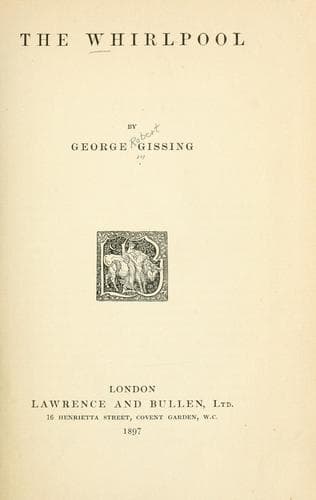
England -- Social life and customs -- 19th century -- Fiction; English fiction -- 19th century
Meanwhile trouble was once more brewing in the back regions of the
house. The cook made an excuse for 'giving notice'. Rolfe, in his fury,
talked about abandoning the house and going with wife and child to some
village in the heart of France; yet this was hardly practicable. Again
were advertisements sent forth; again came the ordeal of
correspondence--this time undertaken by Harvey himself, for Alma was
unequal to it. The cook whom they at length engaged declared with
fervour that the one thing she panted for was downright hard work; she
couldn't abide easy places, and in fact had left her last because too
little was expected of her.
'She will stay for two months,' said Harvey, 'and then it will be time
for the others to think of moving. Oh, we shall get used to it.'
At the end of March, Alma's second child was born--a girl. Remembering
what she had endured at Hughie's birth, Rolfe feared that her trial
would be even worse this time; but it did not prove so. In a few days
Alma was well on the way to recovery. But the child, a lamentable
little mortal with a voice scarce louder than a kitten's, held its life
on the frailest tenure; there was doubt at first whether it could draw
breath at all, and the nurse never expected it to live till the second
day. At the end of a week, however, it still survived; and Alma turned
to the poor weakling with a loving tenderness such as she had never
shown for her first-born. To Harvey's surprise she gladly took it to
her breast, but for some reason this had presently to be forbidden, and
the mother shed many tears. After a fortnight things looked more
hopeful. Nurse and doctor informed Harvey that for the present he need
have no uneasiness.
It was a Saturday morning, and so cheerful overhead that Rolfe used his
liberty to have a long stretch towards the fields. Hughie, who had no
school today, would gladly have gone with him, but after such long
restraint Harvey felt the need of four miles an hour, and stole away.
He made for Twickenham and Hampton Court, then by a long circuit came
round into Richmond Park. The Star and Garter gave him a late luncheon,
after which he lit his cigar and went idly along the terrace. There,
whom should he meet but Mary Abbott.
She was seated, gazing at the view. Not till he came quite near did
Harvey recognise her, and until he stopped she did not glance in his
direction. Thus he was able to observe her for a moment, and noticed
that she looked anything but well; one would have thought her
overworked, or oppressed by some trouble. She did not see what her eyes
were fixed upon, and her features had a dreaming tenderness of
expression which made them more interesting, more nearly beautiful,
than when they were controlled by her striving will. When Harvey paused
beside her she gave him a startled smile, but was at once herself again.
'Do you care for that?' he asked, indicating the landscape.
'I can't be enthusiastic about it.'
Public-domain text, read in full here on John Shaqi.
Reviews
Reviews
No reviews yet
Be the first to share your thoughts on this work.
Elsewhere in the archive
Join the Discussion
Join the discussion
Sign in to leave a comment or review.
Sign InorCreate an account