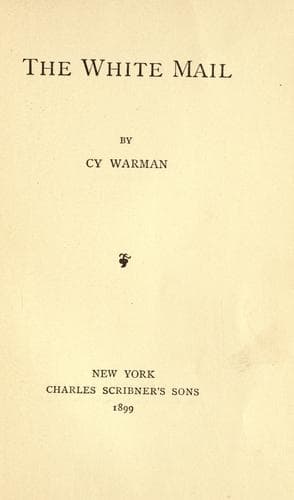
American fiction -- 19th century; Railroad stories
These and many other thoughts were running through the young man’s
almost empty head. Beside him lay a copy of the “Police Gazette” and
a small yellow-back branded “Dead on the Desert;” and when young
Watchem, who held a check for upper seven, saw the literature, he
guessed that this must be Two-card Charley, the amateur and somewhat
theatrical young highwayman. Noting the almost expressionless face and
the nothingness of the man’s physique, the strong young detective felt
sympathy for this would-be criminal.
Retiring to the smoking-room the detective read his letter of
instructions, which was little more and no less than the story of
how the messenger boy and the pump boy had overheard the three
conspirators conspiring to rob the Midnight Express. In Pete, the
chicken-hearted, the shrewd detective recognized “Epsom Pete,” who had
held up a stenographer and burglarized a box car in Kansas City. Of
Two-card Charley he knew nothing, save the little he had gathered from
a few moments’ observation. To begin with, Charley smoked cigarettes
excessively, and that made him wakeful and nervous. He ate opium,
and that wrecked his morals. But Jim--“Cheyenne Jim,” as he called
himself--was a hard nut. His knife-handle, as Watchem was well aware,
was notched for two Chinamen, a sheriff, and a Sioux. He was a coward.
All his men had been killed going, and a conscienceless coward had no
business with a gun. This man must be handled gingerly or somebody
would get hurt.
Presently Charley came and sat in the narrow smoking-room opposite the
detective, but with his gaze bent upon the black window.
“Charley,” said Watchem, puffing at a cigar which he was attempting
to re-light, and instantly Charley’s right hand went back toward his
pistol pocket, “we’re going to have a hard winter, I think,” he added,
between puffs.
“Sir,” exclaimed the robber, bringing his hands in front of him again,
“you have me at some disadvantage.”
“Oh, no! but I’d like to have you so; s’pose you give me your gun.”
Again Charley’s hand went back and his face went chalk white.
“Not so fast, not so fast, my boy,” said the detective, shoving the
point of his own pistol up to Charley’s chin; “slowly now. That’s it,
butt first. Now we can talk.”
But Charley only glared at the detective and refused to say a word.
He had read in the various “works,” with which he was more or less
familiar, that the real game robber never gave up to a detective.
When the fresh locomotive that had been hooked on at Effingham had
galloped over the Ambraw bridge and stopped at Greenup, Epsom Pete
boarded the blind baggage, and a moment later the black steed, snorting
in the frosty morn, was dashing away across Fanchers’ farm.
Public-domain text, read in full here on John Shaqi.
Reviews
Reviews
No reviews yet
Be the first to share your thoughts on this work.
Join the Discussion
Join the discussion
Sign in to leave a comment or review.
Sign InorCreate an account