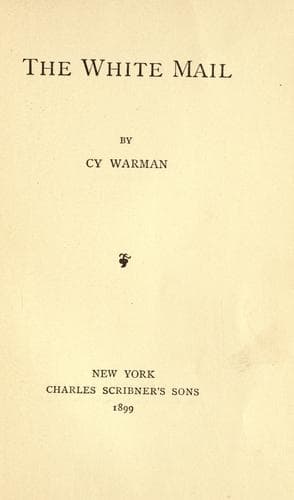
American fiction -- 19th century; Railroad stories
The engine screamed. “That’s St. Jacobs,” said McGuire to his wife,
and the station was behind them. Here the President had his first
disappointment. The man who stood upon the platform in his shirt
sleeves was a stranger. The old agent was in Texas. Now the train sank
into the sag at East Silver, lifted again, as an ocean steamer lifts
her huge form over a high sea, screamed on the ridge, and then went
roaring down toward the bridge. How dwarfed and mean things looked! The
old saw-mill was gone, and only a brown heap of sawdust marked the
place. The mill-pond, into which he had taken many a run and jump from
the railroad grade, was a slimy, stagnant pool covered with green scum.
“Now look, dear!--here--there! There’s where the White Mail got mixed
up with me and the mule.”
“But where’s the bridge, dear? Show me the bridge you used to guard,
and the--”
“There, that’s it. Isn’t it little? Why, I used to fancy that was about
the biggest bridge on the road.”
“But you’re a big boy now, Tommy,” said his wife, patting him playfully
on the back, “and things look different.”
The whistle sounded again, and the “Maid of Erin” whipped round the
curve at Hagler’s tank.
There was a steady pull against the grade for a few moments, and then
the President felt the train falling into the broad bottoms and saw the
bluffs lift in their wake. He turned, and stole a look at the handsome
woman who had left a luxurious home on the Atlantic to follow him
into the West. He began now to appreciate his prize, and his other
successes grew insignificant and mean, like the bridge, and the pond,
and the mill-site. Feeling his glance, she turned her smiling face to
him, bright and beautiful as the breaking morn, and he thought then
that he had tasted what men call happiness.
With a rush and a roar, they swept up the incline, and McGuire,
glancing up and down the river, said, as a man might say in a dream:
“We’re crossing the big bridge on the White Mail.”
TRANSCRIBER’S NOTES:
Minor silent changes have been made to regularize hyphenation and
punctuation.
Dialect, slang and archaic spellings have been retained as typeset.
Public-domain text, read in full here on John Shaqi.
Reviews
Reviews
No reviews yet
Be the first to share your thoughts on this work.
Elsewhere in the archive
Join the Discussion
Join the discussion
Sign in to leave a comment or review.
Sign InorCreate an account