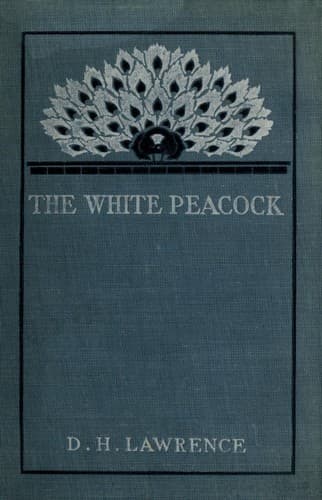
Bildungsromans; Midlands (England) -- Fiction; Young men -- Fiction
“I have no money.”
“Oh!—so you wanted me——?”
“I only wanted you, I only wanted you. I would have given you——”
“What?”
“You’d have me—you’d have all me, and everything you wanted.”
“That I paid for—a good bargain! No, oh no, George, I beg your pardon.
This is one of my flippant nights. I don’t mean it like that. But you
know it’s impossible—look how I’m fixed—it _is_ impossible, isn’t it
now.”
“I suppose it is.”
“You know it is—Look at me now, and say if it’s not impossible—a
farmer’s wife—with you in Canada.”
“Yes—I didn’t expect you like that. Yes, I see it is impossible. But
I’d thought about it, and felt as if I must have you. Should have you .
. . Yes, it doesn’t do to go on dreaming. I think it’s the first time,
and it’ll be the last. Yes, it is impossible. Now I have made up my
mind.”
“And what will you do?”
“I shall not go to Canada.”
“Oh, you must not—you must not do anything rash.”
“No—I shall get married.”
“You will? Oh, I am glad. I thought—you—you were too fond—. But you’re
not—of yourself I meant. I am so glad. Yes—do marry!”
“Well, I shall—since you are——”
“Yes,” said Lettie. “It is best. But I thought that you——” she smiled
at him in sad reproach.
“Did you think so?” he replied, smiling gravely.
“Yes,” she whispered. They stood looking at one another.
He made an impulsive movement towards her. She, however, drew back
slightly, checking him.
“Well—I shall see you again sometime—so good-bye,” he said, putting out
his hand.
We heard a foot crunching on the gravel. Leslie halted at the top of
the riding. Lettie, hearing him, relaxed into a kind of feline
graciousness, and said to George:
“I am so sorry you are going to leave—it breaks the old life up. You
said I would see you again——” She left her hand in his a moment or two.
“Yes,” George replied. “Good-night”—and he turned away. She stood for a
moment in the same drooping, graceful attitude watching him, then she
turned round slowly. She seemed hardly to notice Leslie.
“Who was that you were talking to?” he asked.
“He has gone now,” she replied irrelevantly, as if even then she seemed
hardly to realise it.
“It appears to upset you—his going—who is it?”
“He!—Oh,—why, it’s George Saxton.”
“Oh, him!”
“Yes.”
“What did he want?”
“Eh? What did he want? Oh, nothing.”
“A mere trysting—in the interim, eh!”—he said this laughing, generously
passing off his annoyance in a jest.
“I feel so sorry,” she said.
“What for?”
“Oh—don’t let us talk about him—talk about something else. I can’t bear
to talk about—him.”
“All right,” he replied—and after an awkward little pause. “What sort
of a time had you in Nottingham?”
“Oh, a fine time.”
“You’ll enjoy yourself in the shops between now and—July. Some time
I’ll go with you and see them.”
“Very well.”
“That sounds as if you don’t want me to go. Am I already in the way on
a shopping expedition, like an old husband?”
“I should think you would be.”
“That’s nice of you! Why?”
“Oh, I don’t know.”
“Yes you do.”
Public-domain text, read in full here on John Shaqi.
Reviews
Reviews
No reviews yet
Be the first to share your thoughts on this work.
Elsewhere in the archive
Join the Discussion
Join the discussion
Sign in to leave a comment or review.
Sign InorCreate an account