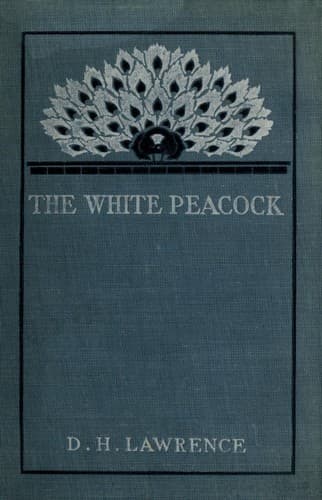
Bildungsromans; Midlands (England) -- Fiction; Young men -- Fiction
“They dun what they can. But it’s a hard job, it is, ter keep ’em all
goin’. Wi’ weshin, an’ th’ parish pay, an’ five shillin’ from th’
squire—it’s ’ard. It was different when my husband was alive. It ought
ter ’a been me as should ’a died—I don’t seem as if I can manage
’em—they get beyond me. I wish I was dead this minnit, an’ ’im ’ere. I
can’t understand it: ’im as wor so capable, to be took, an’ me left. ’E
wor a man in a thousand, ’e wor—full o’ management like a gentleman. I
wisht it was me as ’ad a been took. ’An ’e’s restless, ’cos ’e knows I
find it ’ard. I stood at th’ door last night, when they was all asleep,
looking out over th’ pit pond—an’ I saw a light, an’ I knowed it was
’im—cos it wor our weddin’ day yesterday—by the day an’ th’ date. An’ I
said to ’im ‘Frank, is it thee, Frank? I’m all right, I’m gettin’ on
all right,’—an’ then ’e went; seemed to go ower the whimsey an’ back
towards th’ wood. I know it wor ’im, an’ ’e couldna rest, thinkin’ I
couldna manage——”
After a while we left, promising to go again, and to see after the
safety of Sam.
It was quite dark, and the lamps were lighted in the houses. We could
hear the throb of the fan-house engines, and the soft whirr of the fan.
“Isn’t it cruel?” said Emily plaintively.
“Wasn’t the man a wretch to marry the woman like that,” added Lettie
with decision.
“Speak of Lady Chrystabel,” said I, and then there was silence. “I
suppose he did not know what he was doing, any more than the rest of
us.”
“I thought you were going to your aunt’s—to the Ram Inn,” said Lettie
to George when they came to the cross-roads.
“Not now—it’s too late,” he answered quietly. “You will come round our
way, won’t you?”
“Yes,” she said.
We were eating bread and milk at the farm, and the father was talking
with vague sadness and reminiscence, lingering over the thought of
their departure from the old house. He was a pure romanticist, forever
seeking the colour of the past in the present’s monotony. He seemed
settling down to an easy contented middle-age, when the unrest on the
farm and development of his children quickened him with fresh activity.
He read books on the land question, and modern novels. In the end he
became an advanced radical, almost a socialist. Occasionally his
letters appeared in the newspapers. He had taken a new hold on life.
Over supper he became enthusiastic about Canada, and to watch him, his
ruddy face lighted up, his burly form straight and nerved with
excitement, was to admire him; to hear him, his words of thoughtful
common-sense all warm with a young man’s hopes, was to love him. At
forty-six he was more spontaneous and enthusiastic than George, and far
more happy and hopeful.
Emily would not agree to go away with them—what should she do in
Canada, she said—and she did not want the little ones “to be drudges on
a farm—in the end to be nothing but cattle.”
Public-domain text, read in full here on John Shaqi.
Reviews
Reviews
No reviews yet
Be the first to share your thoughts on this work.
Elsewhere in the archive
Join the Discussion
Join the discussion
Sign in to leave a comment or review.
Sign InorCreate an account